
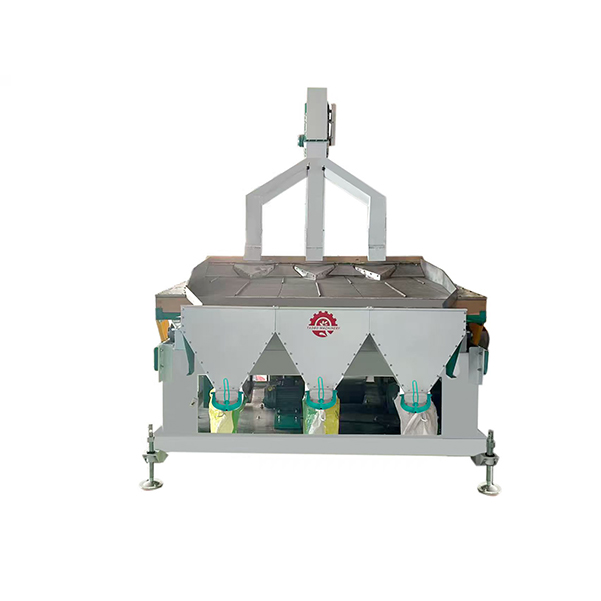
The grain destoner is a core piece of equipment in grain cleaning and processing. It is mainly used to separate impurities such as sand, gravel, and mud that are heavier than the grains from grains (such as wheat, corn, soybeans, and sesame). Its core working principle is gravity separation + vibrating screening + airflow assistance.
Core Working Principle
Vibration and Gravity Separation: The equipment uses a vibrating motor to drive the screen surface in reciprocating vibration, forming a loose material layer on the screen. Since sand and gravel have a much higher density than grains, they gradually sink under vibration, forming the bottom “grain layer”; grains float on the surface, forming the “grain layer.”
Airflow-Assisted Separation: A fan blows air upwards from below the screen surface. As the airflow passes through the material layer, it further lifts the less dense grains, increasing the stratification effect between grains and sand/gravel, while preventing fine grain particles from being discharged with the gravel.
Directional Conveying and Discharge: The screen surface is designed at a certain angle, which, in conjunction with the vibration direction, causes the surface grains to move towards the discharge port; the bottom gravel is guided to the gravel discharge port by the screen’s flow-guiding structure, achieving complete separation of grains and gravel.
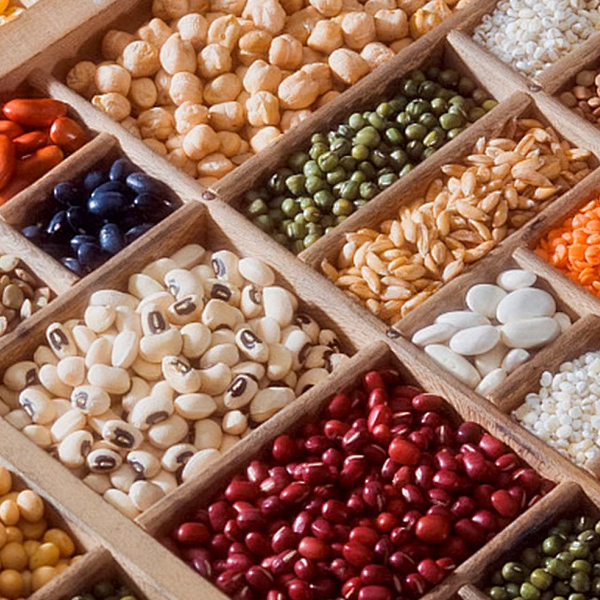
Key Technical Parameters (Core Indicators Affecting Destoning Effect)
Vibration Frequency/Amplitude: Needs adjustment based on material density. Low-density materials (e.g., sesame seeds) require low-frequency, low-amplitude vibration to prevent splashing; high-density materials (e.g., soybeans) require high-frequency, high-amplitude vibration to accelerate stratification.
Airflow: Airflow must match the material layer thickness. Excessive airflow can easily carry away grains, while insufficient airflow results in poor stratification.
Screen Angle: Typically between 3° and 8°. A larger angle results in faster material movement and higher throughput, but shortens residence time, potentially affecting destoning.
Screen Hole Diameter/Porosity: Hole diameter needs to be slightly smaller than the particle size of the grains being cleaned to prevent grain leakage; higher porosity improves airflow penetration and stratification.
When using a grain destoner to clean sesame seeds and soybeans, the key considerations are: adjusting equipment parameters to suit the material characteristics, optimizing the feeding and operating process, and performing proper equipment maintenance to avoid material damage or incomplete destone removal.
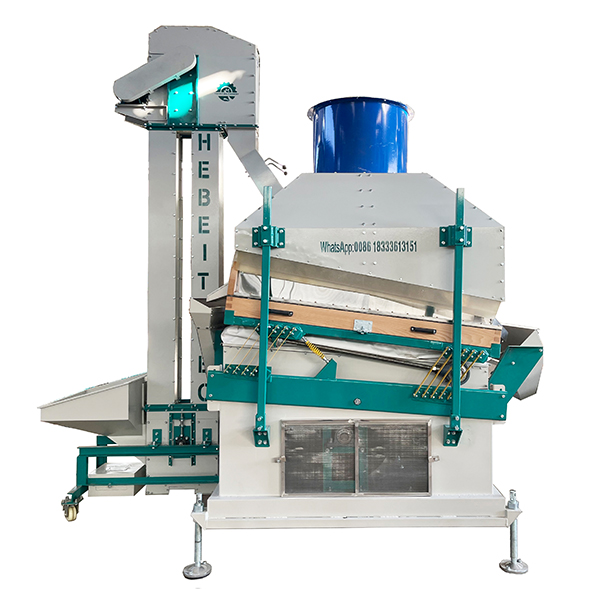
Parameter Adjustments Based on Material Characteristics
Sesame Seed Cleaning Considerations: Sesame seeds are small and have a low density (approximately 0.4~0.6 g/cm³). The density difference between sesame seeds and adjacent stones (gravel with similar particle size) is small. Therefore, reduce the airflow and vibration frequency to prevent the sesame seeds from being carried away by the airflow. Simultaneously, use a fine-mesh screen to avoid sesame seeds missing from the screen. The screen inclination angle should be controlled at 3°~5° to slow down the material movement speed and extend the stone removal time.
Sesame seeds have a high oil content and are prone to sticking. Before feeding, ensure the material moisture content is 6%~8% to prevent clumping and clogging the screen. If the material is damp, pre-dry it first.
Soybean Cleaning Considerations: Soybeans are large and have a high density (approximately 1.1~1.2 g/cm³). The density difference between soybeans and gravel is large. Appropriately increase the airflow and vibration frequency, and adjust the screen inclination angle to 5°~8° to accelerate material conveying efficiency.
Soybeans have a brittle outer skin, so vibration intensity needs to be controlled to prevent breakage. Simultaneously, avoid excessively small screen gaps to prevent soybean jamming.
Operating Procedure Optimization and Standardization:
Feed Control: Maintain uniform and continuous feeding. The feed rate must match the equipment’s processing capacity (sesame feed rate is approximately 50%~60% of soybean feed). Excessive feeding will result in an overly thick material layer, hindering effective sand and gravel separation; insufficient feeding will reduce equipment utilization.
Output Monitoring: Real-time monitoring of the material quality at the outlet. If there are still stones in the sesame output, slightly increase the airflow or extend the material’s residence time on the screen. If soybeans are broken, reduce the vibration frequency or decrease the screen inclination angle.
Separate Processing: Sesame and soybeans have significantly different physical properties; mixing them for cleaning is strictly prohibited. Parameters must be adjusted separately for each batch.
Equipment Maintenance and Safety Requirements
Screen Cleaning: Clean the screen surface of any residual material and impurities before and after operation to prevent screen blockage. Regularly check the screen surface for damage, as damage can lead to material leakage or reduced stone removal efficiency.
Component Inspection: Regularly tighten the bolts on components such as the vibrating motor and springs to prevent uneven vibration due to loosening. Check the fan impeller for dust accumulation, as excessive dust can affect airflow stability.
Safety Precautions: Disconnect the power supply before cleaning the inside of the equipment. Ensure the equipment’s protective cover is intact during operation to prevent material splashing and injury.
Post time: Dec-10-2025