
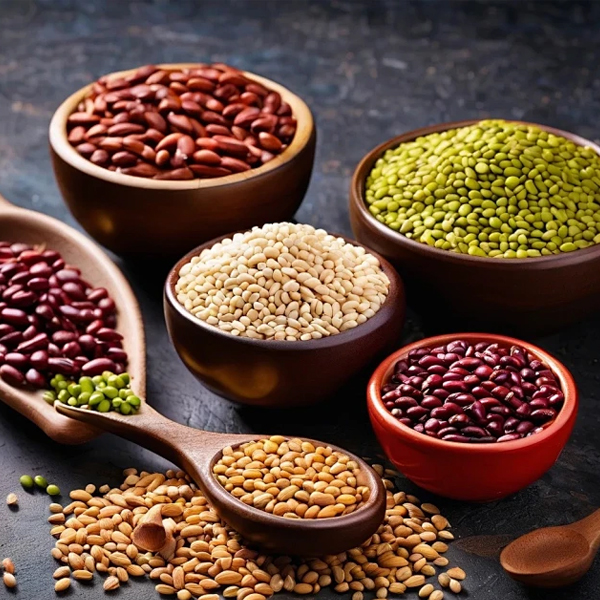
When processing small-grained materials with significant differences in specific gravity—such as legumes (mung beans, soybeans, pinto beans, etc.) and sesame seeds—the critical considerations for wind-screen cleaners and gravity separators center on: precise parameter matching, prevention of breakage and material loss, prevention of clogging, the sequence of grading and cleaning operations, and safety and maintenance protocols.
I. Air-Screen Cleaner (Air Separation + Screening): Important Considerations
The air-screen cleaner utilizes a combination of airflow velocity (air separation) and screen apertures (screening) to separate large impurities, light impurities, and fine impurities. Legumes feature large particle sizes and high density; sesame seeds, conversely, have extremely small particle sizes, low density, and are prone to scattering—thus, the operational parameters for these two types of materials differ completely.
1. Material Pre-treatment (Mandatory)
Removal of Large Impurities: Prior to processing, manually remove—or use a preliminary cleaning screen to eliminate—straw, clumps of soil, long weeds, and large stones. This prevents screen clogging and damage to the screen mesh.
Moisture Control:
Legumes: An ideal moisture content is 12%–14%. If the moisture level is too high, the beans are prone to sticking together or fracturing; if too low, excessive dust is generated, and the bean skins become brittle.
Sesame: An ideal moisture content is 9%–11%. If too wet, the seeds will clump together, preventing effective airflow penetration; if too dry, they are easily blown away by the airflow, resulting in significant material loss.
Removal of Ferrous Impurities: Incorporate a magnetic separation stage before feeding the material into the machine; otherwise, iron nails or screws could tear the screen mesh or jam the blower fan.
2. Screen Selection (Key Factor: Based on Material Particle Size)
Legumes (Mung Beans / Soybeans / Speckled Beans)
Upper Screen (Large Impurities): 8×8 mm to 12×12 mm (square or oblong apertures) → Removes straw and large soil clumps.
Middle Screen (Grading / Clean Grain): 4.5×25 mm to 6×6 mm → Grades the beans according to their particle size.
Lower Screen (Fine Impurities): 3.5×3.5 mm to 4×4 mm → Allows broken beans, fine sand, and small impurities to pass through.
Sesame Seeds
Upper Screen: 6×6 mm to 8×8 mm → Removes grass stalks and large impurities.
Middle Screen (Clean Grain): 2.0×2.0 mm to 2.5×2.5 mm → Allows sesame seeds to pass through while retaining “companion” impurities (impurities of similar size).
Lower Screen: 1.2×1.2 mm to 1.5×1.5 mm → Allows broken sesame seeds and fine sand to pass through.
General Principle: For sesame seeds, use screens with smaller apertures and thinner mesh; for legumes, use screens with slightly larger apertures and thicker mesh. 3. Wind Speed / Air Volume (Most Prone to Error)
Beans (Heavy Grains)
Wind Speed: 8–11 m/s; Air Gate Opening: 60%–80%.
Standard: Light impurities (shriveled grains, leaf fragments, dust) are blown away; sound beans are not blown out; the proportion of sound beans carried into the light impurity outlet is <1%.
Sesame (Light, Easily Airborne)
Wind Speed: 5–8 m/s; Air Gate Opening: 30%–50% (significantly smaller than for beans).
Standard: Only dust, shriveled sesame seeds, and leaf fragments are blown away, while the loss of sound sesame seeds is minimized.
Major Pitfalls: Wind is too strong → massive loss of sesame seeds, high wastage; Wind is too weak → incomplete cleaning.
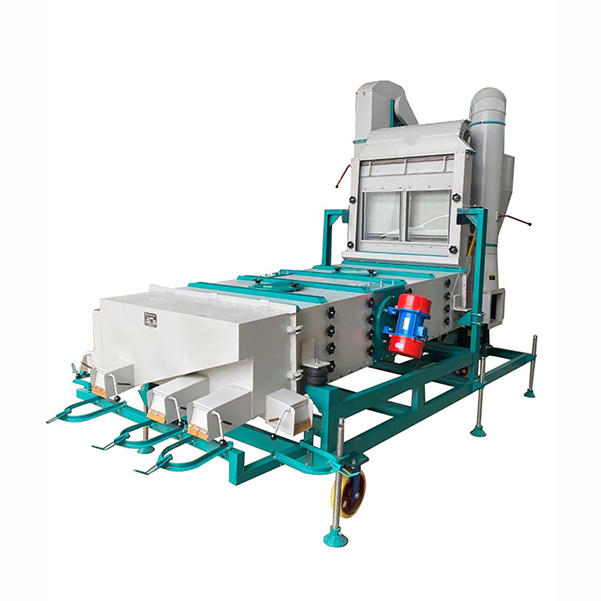
II. Gravity Separator (Gravity / Specific Gravity Cleaning Machine): Important Considerations
Gravity separators perform separation based on density or specific gravity, removing items such as stones, mud lumps, insect-damaged grains, moldy grains, immature grains, and hollow or shriveled grains. For crops like sesame and beans, the precision requirements are extremely high, and the machine parameters are highly sensitive.
1. Selection of Deck / Screen Mesh
Beans: Use a steel wire mesh with a relatively large aperture (3.0–4.0 mm); this provides good support and resists clogging.
Sesame: Use a fine-mesh screen or fabric surface (featuring small, dense perforations) to prevent sesame seeds from falling through and to ensure proper fluidization.
Strictly Prohibited: Using a large-aperture deck to screen sesame (results in significant product loss); using a small-aperture deck to screen beans (results in poor stratification and high energy consumption).
2. Core Parameters (Deck Angle, Air Volume, Amplitude)
General Principle: The material on the deck should exhibit a “wave-like boiling” motion with clear stratification, without rolling uncontrollably or intermingling between layers.
Beans (Higher Specific Gravity)
Deck Angle: 6°–9°.
Air Volume: Medium to high; this ensures the bean grains are fully suspended and stratified.
Amplitude: 4–6 mm.
Standard: Heavy impurities (stones, mud lumps) move upward; good beans move downward; light impurities (shriveled grains, moldy grains) float to the top layer and are removed by suction.
Sesame (Lower Specific Gravity, Extremely Fine Grains)
Deck Angle: 4°–6° (lower than that for beans).
Air Volume: Relatively low and stable; if too high, the sesame seeds will scatter and stratification will be disrupted; if too low, fluidization will not occur, and separation will be ineffective.
Amplitude: 3–4 mm (low amplitude, smooth operation).
Standard: The material exhibits a gentle boiling motion without scattering; a clear boundary is visible between heavy impurities (sand, stones, mud particles) and the good sesame seeds.
3. Feeding and Flow Rate Control
Feeding must be uniform and in a thin layer; for sesame, it is strictly forbidden to “dump the entire batch at once,” as this leads to piling, a lack of stratification, and poor separation.
Feed Rate: It is better to err on the side of a lower rate than a higher one; start with a low flow rate to stabilize the process, then gradually increase it.
High Impurity Content: Reduce the feed rate, extend the sorting path (by adjusting machine settings), and increase the air volume.
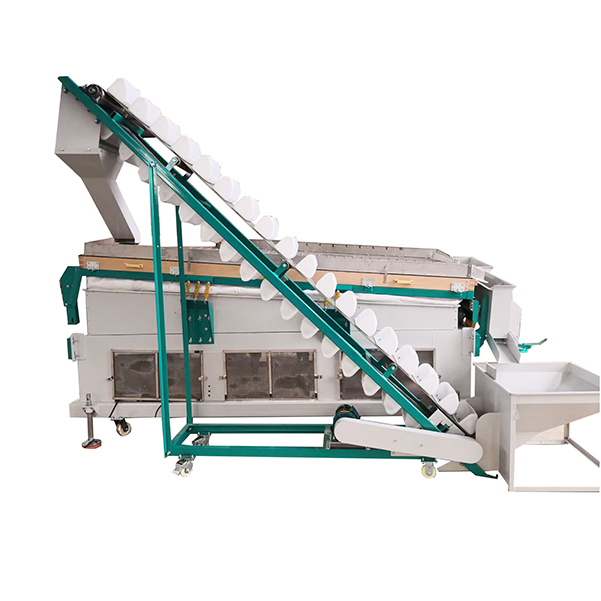
III. Legumes vs. Sesame: Key Differences Compared
Air-Screen Cleaner
Legumes: High airflow velocity (8–11 m/s), large screen apertures, slightly higher feed rate, stronger vibration, designed to prevent breakage.
Sesame:Low airflow velocity (5–8 m/s), small screen apertures, lower feed rate, gentle vibration, designed to prevent scattering and loss.
Gravity Separator
Legumes: Table inclination 6°–9°, moderate airflow volume, larger vibration amplitude, wire mesh deck, vigorous stratification.
Sesame: Table inclination 4°–6°, slightly lower airflow volume, smaller vibration amplitude, fine-mesh screen / fabric deck, gentle fluidization.
IV. General Safety and Maintenance
1. Before Startup
Check the screens/deck for any damage, looseness, or blockages.
Ensure the fan, transmission system, belts, and safety guards are intact.
Run the machine idle for 5–10 minutes; verify there are no abnormal noises and that vibration is normal.
2. During Operation
Strictly prohibit inserting hands into moving parts or the feed inlet.
Monitor continuously: discharge quality, grain loss in the waste stream, material flow status, abnormal noises, and overheating.
3. Shutdown Procedure
Stop feeding first → Allow internal material to clear completely → Stop the fan/vibration → Cut off power.
Sesame: Before shutting down, reduce the airflow volume and slow down the discharge process to minimize material residue and scattering.
4. Per-Shift Maintenance
Clean the screens/deck, fan, air ducts, and dust collection bags (sesame generates significant dust, so frequent cleaning is mandatory).
Check for loose fasteners, apply lubrication, and verify belt tension.
Post time: Apr-03-2026