
In the coffee bean cleaning process, both gravity separators and destoners are machines that sort impurities based on differences in density (weight); however, their specific functions are entirely distinct: one is dedicated exclusively to removing stones, while the other specializes in separating defective beans from sound ones. Together, they constitute two critical stages for ensuring that the coffee beans are clean, uniform, and free of impurities.
During the various stages of harvesting, processing, and transportation, coffee beans can become mixed with a wide variety of impurities. These include, for instance: pebbles, coffee leaves, small twigs, straw fragments, fruit peels, pulp residue, broken shells, dust, shriveled beans, insect-damaged beans, moldy beans, and others.
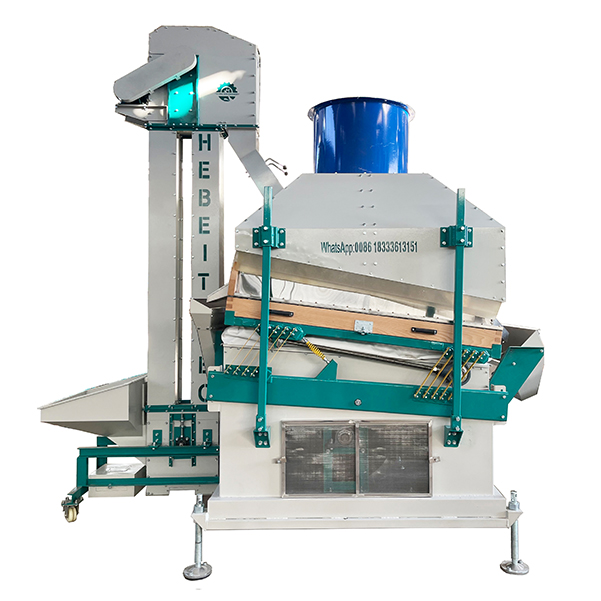
I. Function of the Destoner (Specific Gravity Destoner)
Core Task: To remove heavy impurities—such as stones, clods of earth, and metal particles—from coffee beans.
Working Principle
By leveraging the density difference between coffee beans and stones, the machine employs a combination of upward airflow and a vibrating screen surface to cause the heavier stones to “float” upward while the lighter beans “sink” downward, thereby achieving automatic separation.
Basic Operating Mechanism
Material Infeed
Coffee beans (mixed with stones, clods, and soil lumps) enter the machine at the central section and land upon a screen plate featuring fish-scale perforations or a porous surface.
Continuous Upward Airflow from Below
A blower located beneath the screen plate directs air upward, generating a rising airstream:
Due to their lower density, the coffee beans are slightly lifted by the airflow, entering a state of suspension or semi-suspension.
Due to their higher density and greater weight, the stones and clods cannot be supported by the airflow; instead, they pass through the layer of beans and settle firmly against the surface of the screen plate.
Screen Plate Vibration and Tilting Motion
The screen plate undergoes high-frequency, low-amplitude reciprocating vibrations while being tilted upward at an incline:
The stones, remaining in firm contact with the screen plate, migrate toward the higher end of the screen surface in the direction of the vibration.
The coffee beans, floating in the upper layer, slide downward toward the lower end of the screen surface under the influence of gravity.
Separate Discharge
Upper End of Screen Plate: Discharges stones, clods, and heavy impurities.
Lower End of Screen Plate: Discharges the cleaned coffee beans.
Role in Coffee Bean Cleaning
Prevents stones from entering subsequent hulling machines or grinders, thereby avoiding equipment damage and protecting cutting blades.
Prevents uneven heat absorption by stones during roasting—a phenomenon that can cause “popping” incidents (damaging the batch) or inflict physical damage upon the roasting machine.
Ensures that the finished coffee beans are free of stones and hard impurities, thereby meeting both export and food safety standards.
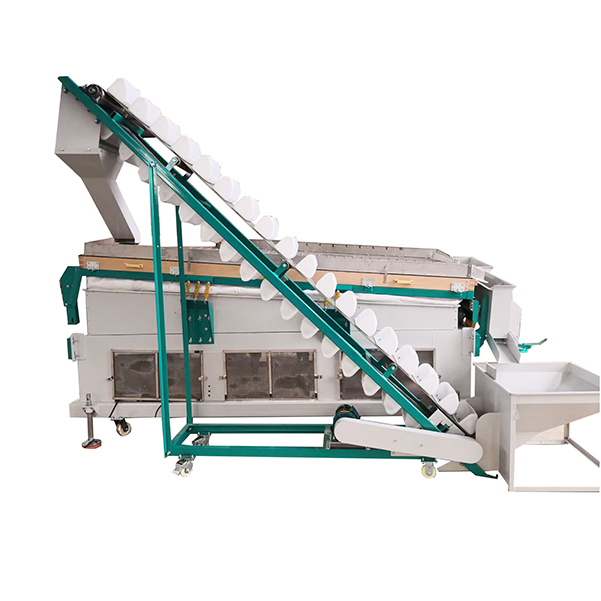
II. The Function of the Gravity Separator (Specific Gravity Sorter / Gravity Table)
Core Objective: To separate good beans from bad beans, and to sort beans of varying weights, thereby enhancing uniformity.
Working Principle
By utilizing a combination of vibration and upward airflow, the machine stratifies the material based on density and fullness, effectively separating the heavier, high-quality beans from the lighter, defective beans and impurities.
1. Overall Working Mechanism
Material Infeed
Coffee beans fall evenly onto an inclined, perforated vibrating screen deck.
Upward Airflow
A fan forces air upward through the small perforations in the screen deck, creating an air cushion:
Full, mature, high-density beans (Good Beans): Heavy; they settle to the lower layer, resting directly against the screen deck.
Shriveled, insect-damaged, moldy, broken beans, and empty shells: Light; they are lifted by the airflow and float in the upper layer.
Vibration-Induced Movement
The screen deck undergoes a reciprocating vibration, propelling the beans along the inclined surface:
Heavy Good Beans: Remaining in close contact with the screen deck, they move in the direction of the vibration toward the higher end of the incline.
Light Defective Beans / Impurities: Floating on the surface, they are pushed toward the lower end of the incline by the combined forces of the airflow and vibration.
Zoned Discharge
The machine features multiple discharge outlets positioned at different heights, resulting in the final separation into:
High End: Full, premium-quality beans.
Mid End: Intermediate-quality beans (which can be recirculated through the machine for re-sorting).
Low End: Shriveled beans, insect-damaged beans, broken beans, and light impurities.
2. Role in Coffee Bean Cleaning
Removes insect-damaged, shriveled, moldy, and broken beans, as well as empty shells.
Standardizes the fullness and density of the beans, ensuring more uniform roasting in subsequent stages—preventing some beans from becoming scorched while others remain under-roasted.
Enhances the visual appearance and flavor consistency of the final coffee product, thereby elevating its grade and market value.
Simple Summary: Gravity Separator = Quality Machine; its sole purpose is to select the good beans and discard the bad ones.
Post time: Mar-31-2026