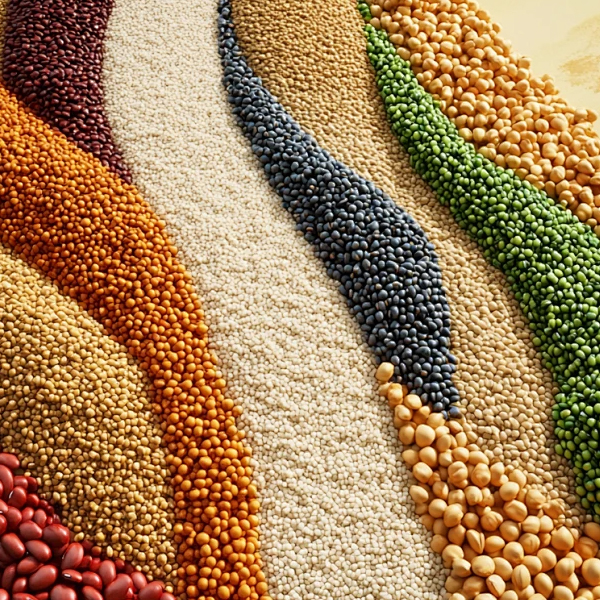
The most produced legume in Mozambique is pigeon pea (also known as dove bean), followed by common bean (mainly red kidney bean), cowpea, and peanut.
I. Pigeon Pea
Production Ranking: Jumped from fifth place in 2001-02 to the number one legume crop since 2011-12, consistently leading in recent years.
Production Trend: Annual growth rate of approximately 7.0%, making it the fastest-growing legume in Mozambique, mainly grown in the central and northern regions.
Main Uses: Domestic staple food, export for foreign exchange earnings (mainly to India).
II. Common Bean (including red kidney bean)
Production Scale: The national average annual production is approximately 200,000 tons, making it an important legume producer in Southern Africa.
Varieties: Mainly red kidney bean, with other varieties such as white kidney bean and spotted kidney bean.
Distribution: Widely cultivated throughout China, with the most concentrated production areas in central China.
III. Cowpea
Yield and Status: One of the traditional main cultivated legumes, with stable yields, ranking among the top three.
Characteristics: Drought-resistant and tolerant of poor soil, it is an important food and cash crop for smallholder farmers.
IV. Soybean – A Rapidly Expanding Strategic Oilseed/Protein Crop
Planting Scale: Explosive growth in recent years, reaching 186,000 hectares and 450,000 tons in 2023, accounting for nearly 70% of total soybean production.
Main Producing Areas: Southern region (Gaza, Inhambane), concentrated in contract farming.
Planting Model: Contract farming + moderate mechanization, high coverage of improved varieties; yield 3.0–4.3 tons/hectare (significantly higher than traditional crops).
Uses: Oil extraction, animal feed, export; government-positioned as a core crop for import substitution and processing development.
Trend: Driven by government and foreign investment, acreage and yield continue to increase rapidly, making it the most promising crop for large-scale production.
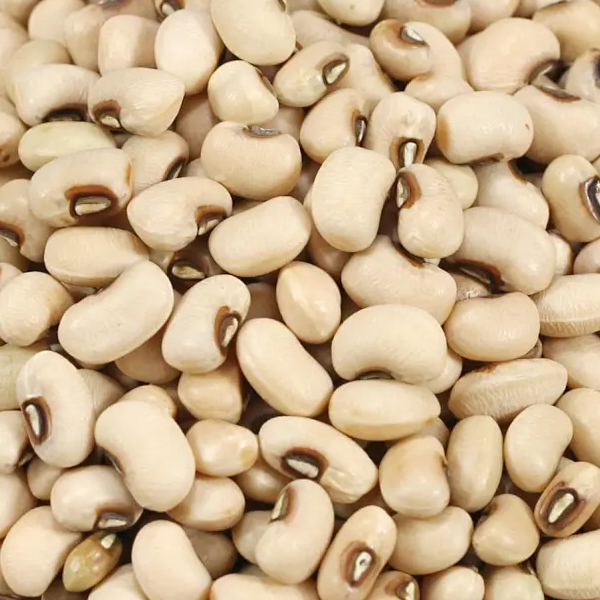
How does an air-screen cleaner handle impurities in pigeon beans?
I. Common Impurity Types in Pigeon Beans
Light Impurities: Dust, broken leaves, shriveled beans, insect-damaged beans, empty pods, husks (suspension velocity is much lower than that of plump pigeon beans)
Large Impurities: Straw, pods, stones, mud lumps, weeds (size larger than pigeon beans)
Small Impurities: Broken beans, sand, small debris (size smaller than pigeon beans)
II. Air-Screen Cleaner Processing Flow (Standard Model)
1. Feeding and Pre-Air Screening (Front Suction Duct)
Pigeon beans fall evenly into the front suction duct through the feeding hopper and feeding rollers, where they are subjected to the vertical upward airflow.
Light impurities (dust, broken leaves, shriveled beans) are drawn into the front settling chamber by the airflow due to their low suspension velocity, and are discharged by the light impurity auger after settling.
Plump pigeon beans and heavy impurities (stones, mud lumps) fall to the upper screen surface because gravity is greater than the lift force of the airflow.
2. Upper Screen: Removes Large Impurities
The screen surface vibrates reciprocally, causing the material to slide down and separate into layers.
The upper screen apertures (e.g., 8–10 mm) are larger than the pigeon bean particle size, preventing large impurities (straw, pods, stones) from passing through. These impurities slide down the screen surface to the large impurity outlet.
Pigeon beans and small impurities pass through the apertures and fall into the middle screen.
3. Middle Screen: Selects the Main Components and Separates Small Impurities
The middle screen apertures (e.g., 5–6 mm) are matched to the size of plump pigeon beans.
Small impurities (broken beans, sand, fine debris) pass through the apertures and fall to the lower screen or the small impurity outlet.
Qualified pigeon beans remain on the screen surface and slide into the rear suction duct area.
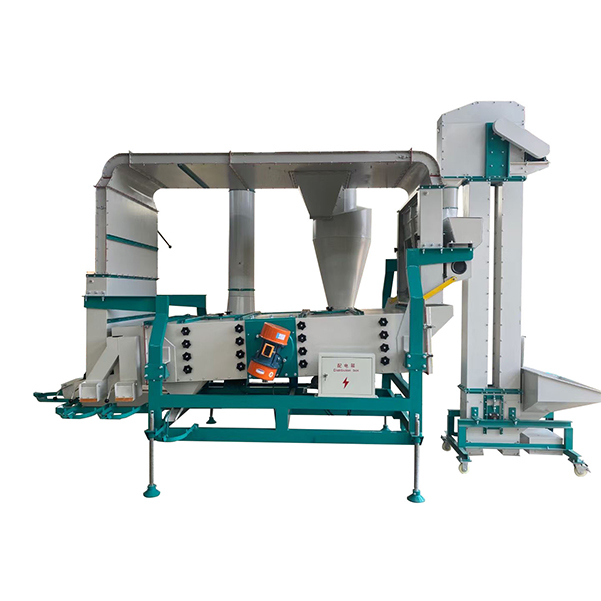
4. Rear Suction Duct: Secondary Air Separation to Remove Residual Light Impurities/Chives
The pigeon beans from the middle screen pass through the rear suction duct and undergo secondary air separation under the influence of a strong upward airflow.
Residual light impurities, shriveled grains, and insect-damaged grains are blown into the settling chamber and discharged; plump pigeon beans settle and enter the good bean outlet.
5. (Optional) Lower sieve: Fine impurity removal/grading
Some models are equipped with a lower small-mesh sieve (e.g., 3–4mm) to further remove extremely fine impurities and improve purity.
III. Core Separation Principles (for Pigeon Beans and Cowpeas)
Air Separation Principle: Utilizing the difference in suspension velocity. Plump pigeon beans have a suspension velocity of approximately 6–8 m/s, while light impurities have a velocity of only 2–4 m/s. Precise separation can be achieved by adjusting the fan airflow (5–7 m/s).
Screening Principle: Utilizing the difference in geometric dimensions. Pigeon beans have a particle size of approximately 5–7 mm. By matching the sieve apertures, “large impurities are sieved upwards, small impurities are sieved downwards, and good beans remain in the middle.”
IV. Key Parameters and Effects of Pigeon Bean and Cowpea Cleaning
Sieve Aperture Configuration: Upper sieve 8–10 mm (removes large impurities), Middle sieve 5–6 mm (selects finer impurities), Lower sieve 3–4 mm (removes small impurities).
Airflow Control: Front suction duct 5–6 m/s, rear suction duct 6–7 m/s, to avoid blowing away plump beans or missing light impurities.
Cleaning effect: The purity can reach over 98%, effectively removing dust, shriveled grains, broken beans, straw, stones, etc.
Post time: Mar-24-2026