
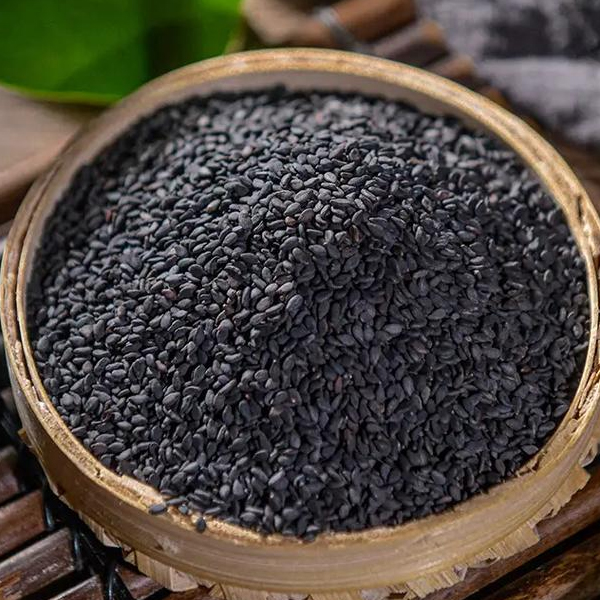
When sesame is freshly harvested, there are many kinds of impurities. These include sesame stalk fragments, small pieces of stems, leaf fragments, calyxes, shriveled sesame pods, weed seeds, weed stems, weed leaves, small stones, sand, and soil particles. These are the most common impurities during harvest, and the proportion of these impurities will be even higher when harvested mechanically.
These impurities not only reduce the commercial value of sesame seeds, but may also wear out processing equipment and affect the quality of subsequent oil extraction or consumption. Therefore, they need to be gradually cleaned after harvesting using equipment such as wind screen cleaners and gravity separators.
Air Screen Cleaner: Removing Light Impurities and Large/Small Particle Impurities. The core function of the air screen cleaner is to initially remove light impurities and impurities with large size differences from sesame seeds. It is the first crucial step in sesame seed cleaning.
Air Sorting Section: Utilizing the difference in suspension velocity between sesame seeds and light impurities (such as dust, shriveled husks, broken straw, and shriveled sesame seeds), an adjustable airflow blows away impurities lighter than sesame seeds, retaining plump sesame seeds.
Screening Section: Equipped with screens of different apertures, it achieves graded screening through a vibrating screen surface.
Small-Aperture Screen: Intercepts sesame seeds and removes smaller impurities (such as mud particles, small stones, and debris).
Large-Aperture Screen: Allows sesame seeds to pass through and removes larger impurities (such as large stones, whole straw, and clumps of weed seeds).
Applicable Scenarios: Preliminary impurity removal after sesame harvesting, reducing the processing load on subsequent equipment.
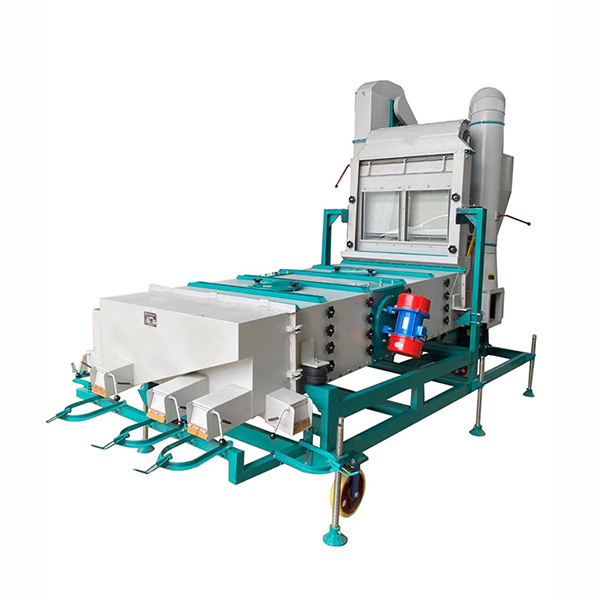
Overall Workflow: Sesame raw materials enter the equipment through the feed inlet → first pass through the air-powered cleaning zone, where light impurities are carried away by the airflow → the remaining material falls onto the vibrating screen surface → large impurities are intercepted and discharged by the upper screen, while small impurities pass through the lower screen and are discharged → qualified sesame seeds are collected from the finished product outlet.
The core logic of a gravity separator is to separate particles based on density differences. Considering the characteristics of sesame seeds, the specific working process is as follows:
Prerequisite: After air sieving, most large and light impurities in the sesame seeds have been removed, leaving behind sesame seeds, small stones (similar in size to sesame seeds), soil clumps, shriveled seeds, and other “difficult-to-separate impurities.”
Core Action: The equipment has an inclined vibrating screen (adjustable angle), while a low-speed reverse airflow is blown onto the screen surface (the airflow speed is much lower than that of the air sieving machine to avoid blowing away the sesame seeds).
Separation Process:
Heavy Impurities (Small stones, glass fragments, hard soil clumps): These have a density much greater than sesame seeds (sesame seed density is approximately 1.1-1.2 g/cm³, while stones have a density of approximately 2.6 g/cm³), so they adhere tightly to the screen surface and move towards the higher end of the screen under vibration, eventually being discharged from the “heavy impurity outlet.”
Light Impurities (Immature shriveled seeds, dried sesame seeds, small straw fragments): These have a density less than sesame seeds, so they are lifted by the reverse airflow and move towards the lower end of the screen under vibration, ultimately being discharged from the “heavy impurity outlet.” The impurities are discharged through the “light impurity outlet”; qualified sesame seeds have a moderate density, so they will not be lifted by the airflow or move close to the upper part of the screen surface. They will remain in the middle area of the screen surface and be collected from the “finished sesame seed outlet” to achieve precise purification.
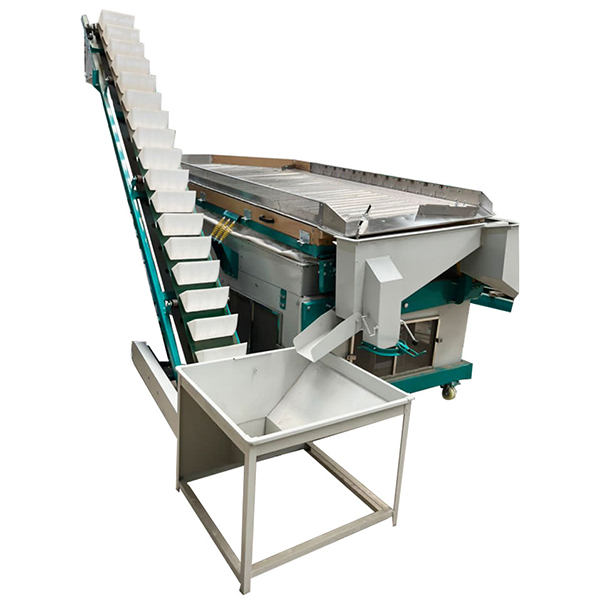
Grading Screen: The core function of the grading screen is to precisely grade the cleaned sesame seeds according to their particle size, rather than primarily removing impurities. It is a crucial process for enhancing the commercial value of sesame seeds.
Working Principle: Equipped with multiple layers of grading screens with varying apertures, the screen aperture decreases from top to bottom. When sesame seeds pass through the vibrating screen surface, particles of different sizes pass through the subsequent layers of screens, thus being separated into large, medium, and small grades.
Applicable Scenarios: Meets various processing needs. For example, large sesame seeds are used for direct consumption or high-end oil processing, while small and medium-sized seeds are used as food ingredients. Furthermore, the graded sesame seeds ensure consistency in subsequent drying and oil extraction processes.
A typical process using these three components together: Sesame raw material → Air sieve cleaner (preliminary removal of light impurities and large/small particles) → Gravity analyzer (fine removal of adjacent stones and shriveled seeds) → Grading sieve (grading by particle size) → Finished sesame product
Post time: Dec-09-2025