
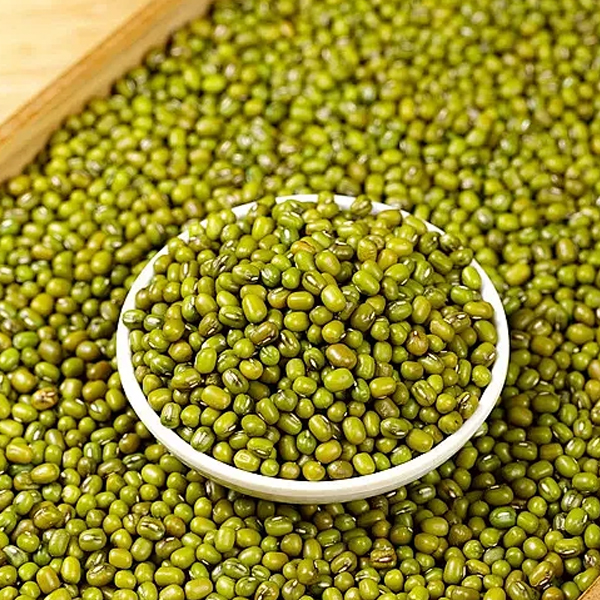
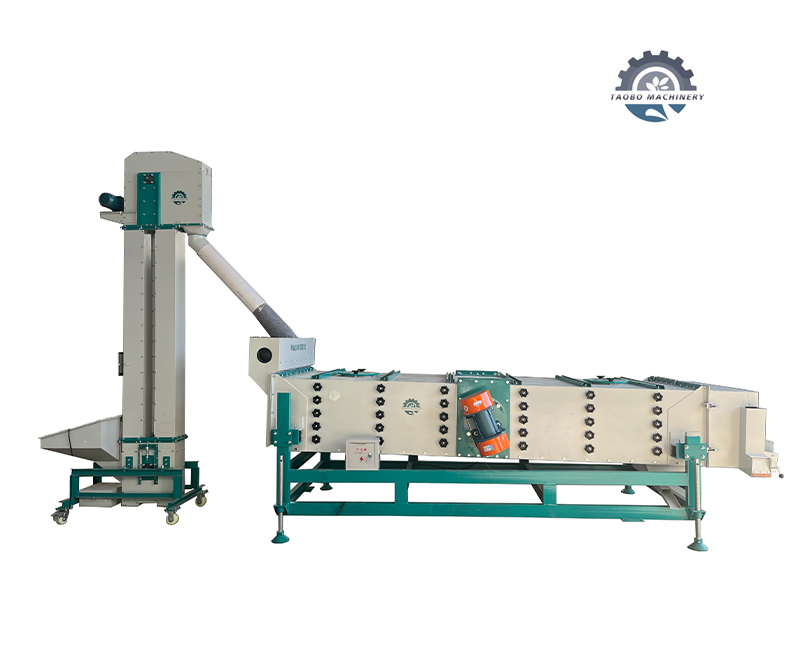
During the processing of mung beans, the grading sieve primarily separates impurities and grades the beans based on particle size, while the gravity separator primarily removes stones, shriveled grains, moldy kernels, and similar contaminants based on specific gravity (density). These two machines are typically used in tandem: the grading sieve is utilized first to remove coarse and fine impurities, followed by the gravity separator to remove lighter and heavier contaminants.
I. Grading Sieve (Vibrating Screen Machine)
1. Working Principle
Leveraging geometric size differences: By utilizing multi-layered screens with varying mesh apertures—combined with vibration (reciprocating or rotary motion) to induce rolling and sliding of the material—particles larger than the mesh openings are retained on the screen, while those smaller than the openings pass through, thereby achieving separation based on size.
Vibration Mode: Typically employs reciprocating linear vibration or planar rotary vibration to ensure the mung beans are evenly dispersed and flow smoothly across the screens.
Screen Configuration: Commonly utilizes a double-layer or triple-layer screen setup (the upper screen removes large impurities; the middle screen retains the finished product; and the lower screen removes fine impurities).
2. Primary Functions
Impurity Removal:
Upper Screen: Removes impurities larger than the mung beans (e.g., stalks, pods, soil clods, twine, broken leaves).
Lower Screen: Removes impurities smaller than the mung beans (e.g., fine sand, broken beans, dust, small shriveled grains).
Grading: Classifies the beans into large, medium, and small grades based on particle size to meet specific commercial specifications.
Protection: Removes large impurities in advance to prevent clogging or damage to subsequent gravity separators.
3. Standard Process (Mung Beans)
Feeding: The mung beans awaiting cleaning are fed evenly onto the upper screen surface.
Coarse Screening (Upper Screen)
Mesh Aperture > Mung Beans: Large impurities are retained and discharged through the large-impurity outlet.
Mung beans + fine impurities pass through the mesh and fall to the middle/lower layer.
Fine Screening (Middle/Lower Screen)
Middle Screen Aperture ≈ Mung Beans: Qualified mung beans are retained on the screen and flow toward the finished product outlet.
Lower Screen Aperture < Mung Beans: Fine sand, broken grains, and small shriveled grains pass through the mesh and are discharged through the fine-impurity outlet.
Discharge: The graded mung beans (large, medium, and small grains) are collected separately.
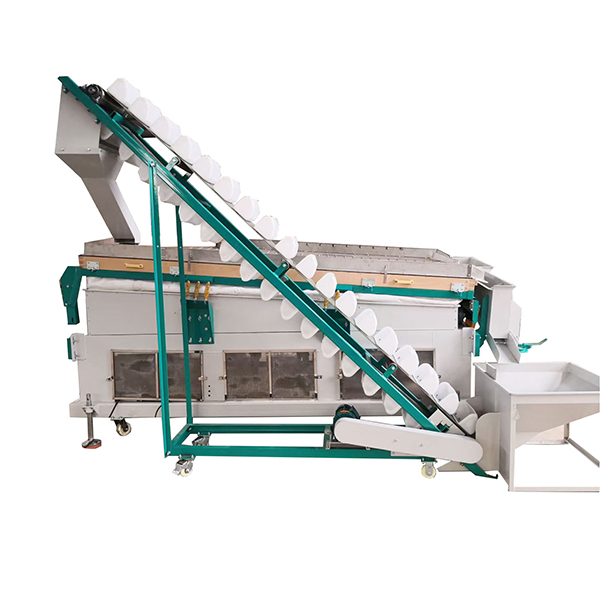
II. Gravity Separator (Specific Gravity Sorter / Destoner)
1. Working Principle
Separation is achieved through the dual action of vibration and airflow, based on differences in specific gravity (density):
Vibration: Causes the material to loosen and fluidize; heavier particles (stones, plump beans) sink, while lighter particles (shriveled beans, insect-damaged grains) float to the surface.
Airflow: Air is blown upward from the bottom; light impurities are lifted and suspended, while heavier materials remain in contact with the screen surface.
Separation Trajectories:
Heavy Impurities (stones, clods of earth): Remain in contact with the screen surface and move in an uphill direction → Discharged via the Heavy Impurity Outlet.
Light Impurities (shriveled grains, insect-damaged grains, moldy grains, bean hulls): Remain suspended and move in a downhill direction → Discharged via the Light Impurity Outlet.
Qualified Mung Beans: Occupy the middle layer and flow steadily toward the Finished Product Outlet.
2. Primary Functions
Destoning: Efficiently separates “companion stones” (stones similar in size to the mung beans) and gravel—impurities that cannot be removed by standard grading screens.
Removal of Defective Grains: Eliminates shriveled grains, insect-damaged grains, moldy grains, broken grains, and sprouted seeds (which have a lower specific gravity than sound beans).
Precision Sorting: Enhances the plumpness, uniformity, and purity of the final product.
3. Standard Process (Mung Beans)
Feeding: Mung beans that have already passed through a grading screen are fed uniformly into the central section of the gravity separation table.
Fluidization and Stratification:
Vibration and airflow cause the material to loosen and automatically stratify into layers.
Bottom Layer: Stones, gravel, and plump beans.
Middle Layer: Qualified mung beans.
Top Layer: Shriveled grains, broken grains, bean hulls, and dust.
Directional Separation:
Heavy Impurities (stones/sand): Move uphill along the screen surface → Destoning Outlet.
Light Impurities (shriveled/moldy/broken grains): Move downhill along the screen surface → Light Impurity Outlet.
Sound Beans: Flow through the middle channel → Finished Product Outlet.
Adjustment: Separation efficiency is optimized by adjusting the airflow volume, vibration frequency, and screen inclination angle.
I. Application Scenarios for Grading Screens
The core function of a grading screen is separation based on size; it is suitable for materials with distinct size differences and is primarily utilized in the following stages:
1. Initial Cleaning of Raw Materials Upon Factory Entry
Freshly acquired mung beans often contain large impurities such as stalks, pods, large soil clumps, twine, and weeds.
Simultaneously, they may contain small impurities such as fine sand, dust, broken beans, and small shriveled grains.
→ A grading screen must be used for preliminary coarse cleaning to protect downstream processing equipment.
2. Particle Grading (Commercial Classification for Sale)
Mung beans intended for export or for packaging in supermarkets require classification into distinct grades: large, medium, and small grains.
Food processing plants and bean sprout cultivation facilities require raw materials with uniform grain sizes.
→ Grading screens precisely separate materials into specific grades based on mesh aperture size.
3. Screening of Post-Crushing Materials
After mung beans have been hulled and crushed, it is necessary to screen out split beans (cotyledons), hulls, and fine fragments.
→ Grading screens rapidly separate products into different specifications.
4. Pre-treatment Before Gravity Separators and Polishers
This prevents large impurities from clogging the screen decks of gravity separators or scratching their surfaces.
It also ensures that the mung beans entering the gravity separator have a more uniform grain size, resulting in improved separation efficiency.
5. Small-Batch and Simple Cleaning Scenarios
Individual farmers or small-scale purchasing stations may only require the removal of large impurities and dust, without the need to remove stones or shriveled grains.
→ Using a grading screen alone is sufficient to meet these basic cleaning requirements.
II. Application Scenarios for Gravity Separators
The core function of a gravity separator is separation based on specific gravity (density); it is specifically designed to process impurities that are similar in size but differ in weight. Typical scenarios include:
1. Removal of “Companion Stones” (A Critical Scenario)
Stones and soil clumps that are nearly identical in size to the mung beans cannot be removed by grading screens.
Food processing plants, export grain suppliers, and oil extraction facilities strictly prohibit the presence of stones; therefore, a gravity separator is mandatory for stone removal.
Precision Selection to Remove Defective Grains (Quality Enhancement)
2. Removal of Shriveled Grains, Insect-Damaged Grains, Moldy Grains, Sprouted Grains, and Broken Grains
These grains are normal in size but possess a lower specific gravity (lighter weight); consequently, grading screens are ineffective in removing them.
→ A gravity separator is the core equipment for the precision sorting of mung beans and for upgrading their commercial grade.
3. High-Standard Finished Product Cleaning
Mung beans for export, premium-grade mung beans, vacuum-packaged mung beans, and mung beans intended for sprouting.
4. Requirements: High purity, free from mold, insect damage, and stones.
→ Must undergo processing by a gravity separator.
A fine-cleaning line integrated with destoners and air-screen separators.
An essential component of the standard grain cleaning workflow for medium-to-large-scale grain storage facilities and processing plants.
5. Versatile Sorting for Various Grains
Cleaning and sorting of mung beans, red beans, black beans, sesame seeds, and other legume seeds.
→ Gravity separators offer high versatility; simply changing the sieve plates allows for processing different grain types.
Post time: Apr-07-2026