
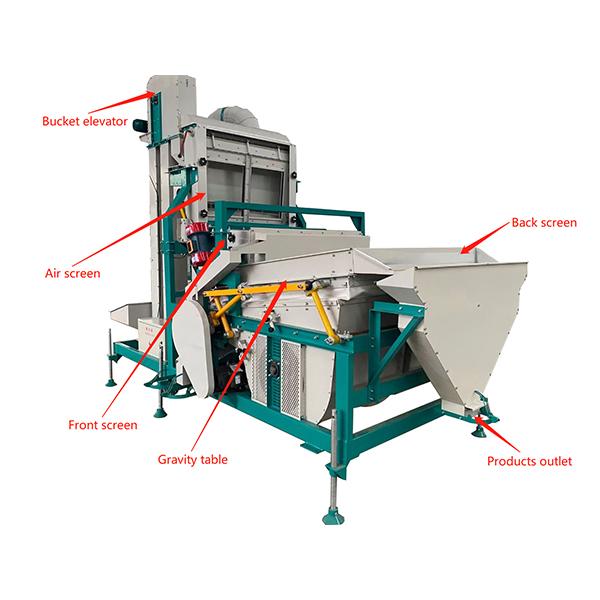
Working Principle of the Air-Screen Gravity Cleaner
This equipment integrates three separation principles—air separation, vibration screening, and gravity separation—to sequentially remove light impurities, oversized/undersized impurities, stones of similar size, and low-quality grains. It is widely used for cleaning agricultural products such as grains, legumes, and sesame seeds.
I. Overall Process
Raw material first enters the air-screen combination section for the preliminary removal of large/small impurities and light debris. It is then fed onto the gravity separation deck, where differences in specific gravity are used to separate heavy impurities (stones, soil clods) and shriveled grains, ultimately yielding the qualified finished product.
II. Detailed Principles by Module
1. Vibration Screening Principle (Screening Unit)
The screen body undergoes reciprocating vibration. Equipped with upper and lower screen layers featuring different aperture sizes, it classifies and removes impurities based on particle size:
Upper screen (large apertures): Retains large impurities such as stalks, pods, and large soil clods, discharging them through the impurity outlet;
Lower screen (small apertures): Allows fine impurities like soil dust and debris to pass through and fall;
Qualified material remains on the screen surface and is conveyed forward by the vibration.
Screen types include long-hole and round-hole designs: long-hole screens are typically used for sesame to prevent clogging, while round-hole screens are used for legumes, matching the specific particle shapes.
2. Air Separation Principle (Air Separation System)
A fan generates a directional airflow, utilizing aerodynamic differences to separate light materials from heavy ones:
At a constant airflow speed, lightweight materials—such as shriveled grains, debris, dust, and leaves—experience greater aerodynamic lift and are blown toward the impurity outlet;
Heavier materials—such as plump grains and stones—possess greater inertia and settle quickly; they are not carried away by the airflow and continue to be conveyed forward.
Airflow speed is adjusted according to material size and weight: low speeds are used for small, lightweight sesame seeds, while higher speeds are employed for larger, heavier legumes. 3. Gravity Separation Principle (Core function of the gravity table: destoning + precision sorting)
This is the most critical component of the equipment. It integrates vibration, airflow, and deck inclination to separate materials into layers based on differences in density and friction coefficients, specifically targeting the removal of “companion stones” (stones similar in size to the grain kernels).
Airflow Action: Air is blown upward from the bottom of the deck, creating a fluidized suspension layer of material. Low-density particles—such as shriveled grains and broken kernels—float at a higher level, while high-density impurities—such as stones and soil clods—remain in close contact with the deck surface.
Vibration Action: The gravity table undergoes directional reciprocating vibration, generating forward and upward thrust. Heavy impurities (stones) in contact with the deck experience greater friction and are driven toward the stone discharge end by the vibration; conversely, suspended, high-quality grains experience less friction and slide down along the deck surface.
Deck Inclination: The deck is set at an angle; combined with vibration and airflow, this controls the material’s flow speed and maximizes the divergence in movement paths between heavy impurities and good grain, ensuring thorough separation.
Based on the equipment structure—comprising the air-sieve system, gravity destoning system, and feed/flow-control components—this guide outlines the adjustment settings and standard parameters for sesame versus various legumes, including practical adjustment logic:
I. Air-Sieve Unit (Pre-cleaning, grading, and removal of light impurities, large debris, and fine dust)
1. Screens (Must be changed; adjustment priority)
Sesame: Upper screen 1.5–2.0 mm slotted holes (removes large debris like stalks and weed seeds); lower screen 1.0–1.2 mm slotted holes (lets fine dust pass through while retaining seeds); slotted holes are less prone to clogging.
Mung beans / Red kidney beans / Adzuki beans: Upper screen 4.0–5.0 mm round holes; lower screen 3.0–3.5 mm round holes.
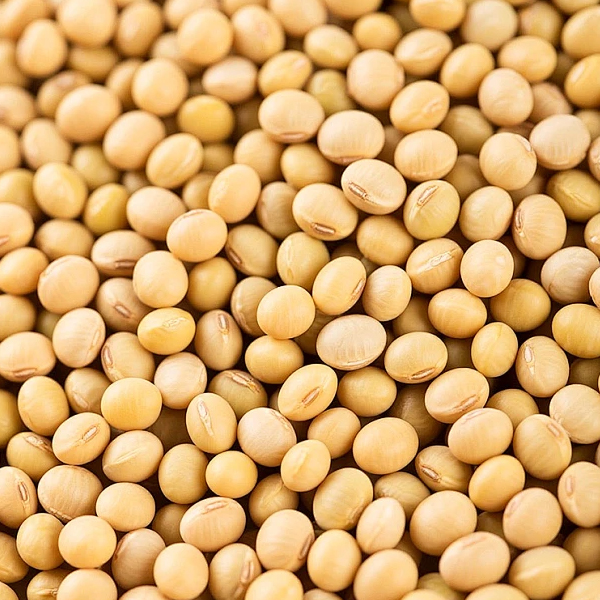
Soybeans: Upper screen 6.0–7.0 mm round holes; lower screen 4.5–5.5 mm round holes.
2. Airflow / Air Damper (Core parameters)
Uses airflow to separate light impurities such as shriveled grains, pod husks, and dust.
Sesame: Main damper slightly open; air velocity 1.2–1.8 m/s; low fan speed; goal is to blow out all light impurities without carrying away intact sesame seeds.
Legumes: Damper opening increased; air velocity 2.0–2.8 m/s for mung/kidney beans, 2.2–3.0 m/s for soybeans; ensures shriveled grains and husks float and are discharged while sound seeds remain stable on the screen surface.
3. Screen Body Vibration (Frequency, amplitude, screen inclination angle)
Vibration Frequency & Amplitude
Sesame: High frequency, low amplitude; smooth vibration to prevent seed breakage or scattering.
Legumes: Medium frequency, relatively high amplitude; accelerates material flow and prevents accumulation or clogging on the screen surface.
Screen Inclination Angle
Sesame: 2°–4°; extends material residence time to improve impurity removal efficiency.
Legumes: 3°–6°; slightly steeper angle to ensure throughput and prevent material buildup.

II. Specific Gravity Destoning Unit (Separates stones, soil clods, and heavy impurities; distinguishes good grain from bad)
1. Specific gravity table airflow and air-bleed valve
Airflow across the table causes material stratification; stones and soil clods float to the discharge outlet, while good grain exits at the lower end.
Sesame: Table airflow velocity 1.0–1.5 m/s; air-bleed valve opening 30%–40%; material exhibits slight undulation without violent tumbling.
Legumes: Table airflow velocity 1.8–2.5 m/s; air-bleed valve opening 40%–60%; stratification is distinct, with a clear boundary between light and heavy materials.
2. Specific gravity table inclination angle
Sesame: 8°–10°; a gentler slope prevents small seeds from rolling off prematurely, ensuring sorting accuracy.
Legumes: 10°–13°; a steeper angle facilitates the movement of stones and soil clods toward the discharge end.
3. Specific gravity table vibration
Sesame: High frequency, low amplitude; minimizes breakage while aiding stratification.
Legumes: Medium frequency, medium amplitude; propels heavy impurities upward, enhancing destoning efficiency.
III. Feeding and auxiliary material-retaining components
1. Feed flow rate
Directly affects material layer thickness and cleaning quality; an overly thick layer results in incomplete cleaning, while an overly thin layer risks material loss.
Sesame: 0.5–1.0 t/h; processed in a thin layer.
Legumes: 1.5–3.0 t/h; flow rate can be appropriately increased.
2. Material-retaining plates and flow-splitting plates at discharge outlets
Sesame: Retaining plate set low (10–15 mm) to suit small-particle material; adjust upward slightly if good grain is carried out through the impurity discharge outlet.
Legumes: Retaining plate set at medium height (15–25 mm); adjust downward if impurity removal is incomplete, or upward if good grain is being lost. IV. Techniques for Rapid On-Site Adjustment and Diagnosis
Air-sifting section: Granules blowing out → reduce airflow (close air damper); light impurities remaining → increase airflow (open air damper).
Specific gravity separation section: Stones failing to discharge → increase airflow / steepen the separation deck angle; good grain mixing with stones → decrease airflow / raise the stone-retaining plate.
Screen clogging: Increase vibration amplitude and slightly raise the screen deck inclination; strictly avoid high vibration amplitudes for sesame seeds to prevent breakage.
Post time: Jun-09-2026