Whether for domestic bean processing plants, coarse grain trading and procurement stations, and seed breeding bases, or for export-oriented deep-processing enterprises specializing in beans imported from South America and Africa, Taobo’s independently developed and designed bean cleaning production lines offer distinct advantages over standardized, off-the-shelf assembly lines. These core strengths include specialized purification processes, material-protecting designs that minimize loss, comprehensive customization capabilities, durable food-grade construction, multi-functional versatility, cost-saving automation, complete support packages for international trade, and seamless one-stop implementation services.
I. A multi-stage, gradient-based impurity removal process tailored to diverse global pulse varieties, ensuring finished product purity meets export inspection standards.
We have customized grading and cleaning workflows based on the specific impurity profiles of domestic and imported pulses—such as soybeans, mung beans, kidney beans, chickpeas, pinto beans, and pigeon peas. Our system employs a multi-stage, integrated impurity removal process—combining magnetic separation, air-screen cleaning, an enlarged gravity separator, gentle polishing, and optical sorting—to overcome the limitations of standard, single-line equipment that often fails to remove impurities thoroughly:
An upstream, high-strength magnetic pipeline separator captures iron filings from field machinery and loose screws from conveyors, preventing metal from scratching screens or damaging optical sorting lenses;
A dual-air-channel air-screen system removes stalks, pods, large soil clods, dust, and light debris, while a sealed negative-pressure dust extraction system prevents dust from re-adhering to the beans;
The core component—an enlarged, wide-bed gravity separator—is the system’s standout feature. It addresses common issues in imported pulses, such as stones and clay clods that match the beans’ particle size. By extending the material’s stratification path and ensuring uniform airflow penetration through damp, clumped raw grain, it achieves a stable stone/sand removal rate exceeding 99%. Simultaneously, it separates out insect-damaged, shriveled, and moldy beans, significantly reducing the percentage of defective grains in the final product;
An optional gentle polishing unit removes surface soil stains and dirt from crevices, enhancing the product’s visual appeal. For seed processing, the system can switch to a low-speed, light-polish mode that preserves the germ and maintains high germination rates;
The final stage features a high-precision optical sorter to accurately remove beans with spots or off-color defects.
Through this multi-layered filtration process, the total impurity content of the finished product is kept below 0.02%. Whether intended for premium retail packaging, canning, soy product processing, or export, the product consistently passes customs and food factory quality inspections without the need for manual re-sorting. II. Line-wide design minimizing breakage and product loss to protect high-value bean raw materials
Mung beans, adzuki beans, and thin-skinned kidney beans have delicate skins; broken beans can only be sold at a discount, while the loss of whole beans into the waste stream directly erodes profits. We have structurally optimized material handling across the entire production line:
Low-drop buffering mechanisms have been installed at all equipment transfer points to minimize impact and collision, keeping the breakage rate for thin-skinned beans under 0.3%;
The gravity separator features a three-layer discharge design with clearly defined separation zones—independently diverting whole beans, stones/grit, and light impurities—resulting in a loss rate of ≤0.3% for good beans, which translates to significant raw material cost savings during long-term, large-scale processing;
Polishing utilizes soft-velvet friction media rather than hard abrasive rollers, preventing skin damage and the generation of excessive split beans;
In contrast, assembly lines cobbled together from standard standalone machines often involve large transfer drops and cramped separation spaces, resulting in breakage and material loss rates 3–5 times higher than our equipment, leading to a marked difference in long-term operational returns.
III. Full-Process Customization: Tailored to Each Client’s Facility, Capacity, and Raw Material Conditions
Taobo maintains an independent R&D engineering team; rather than relying on rigid, standardized templates, we provide bespoke, one-on-one production line designs based on each client’s specific requirements:
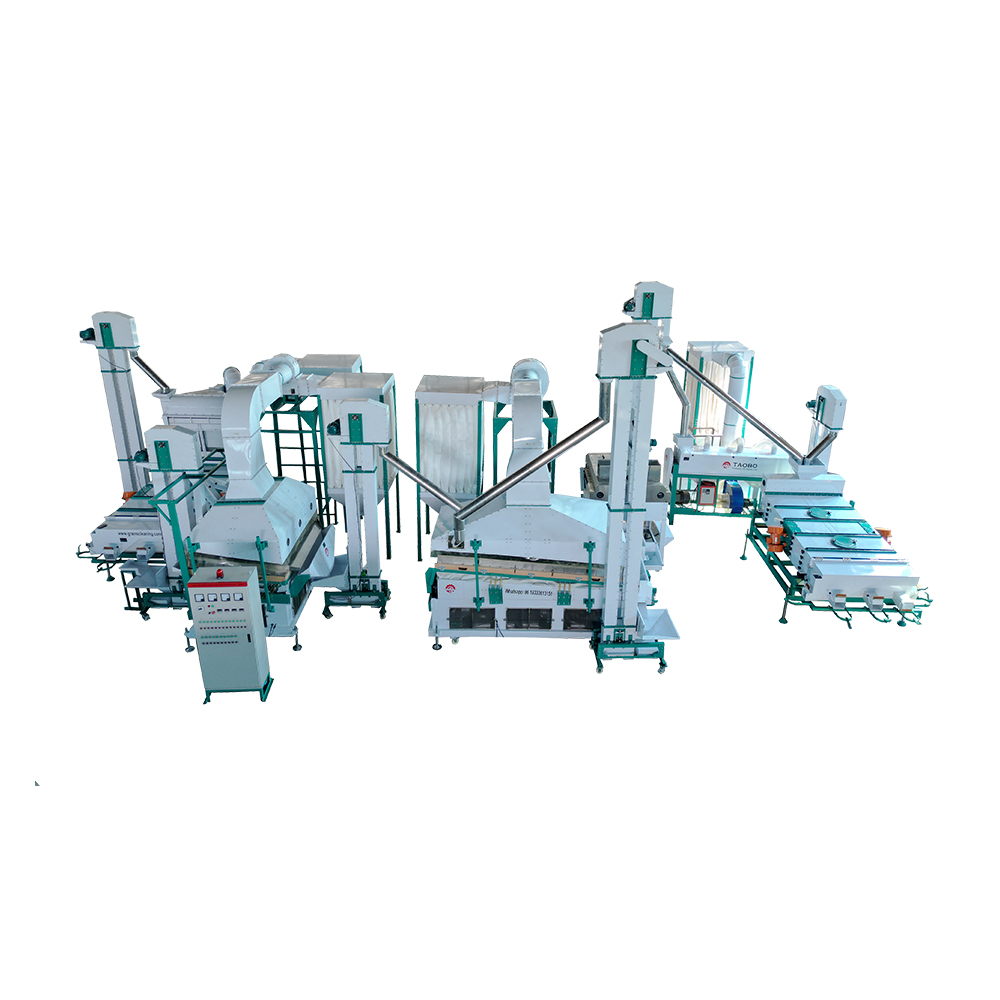
Flexible Capacity Customization: Options range from 2 to 12 tons per hour. We offer streamlined, entry-level models for small collection depots, as well as fully automated, high-spec lines for large-scale export facilities—featuring dual-tandem gravity separators and dual-channel polishers—without forcing the inclusion of unnecessary equipment to inflate the budget.
Customized Facility Layouts: We generate 2D construction blueprints and 3D renderings based on workshop dimensions (length, width, height), column placement, and material flow requirements. Solutions include compact vertical tandem layouts for low-ceiling facilities and modular, detachable structures for overseas plants—designed for 20ft/40ft container shipping—to maximize workshop space utilization.
Modular Flexibility: Easily switch between dry cleaning and wet washing processes; integrate components such as grading screens, buffer silos, automatic packaging machines, and drying units. Add magnetic soil separators for imported beans with high mud content, or adjust vibration and polishing intensity for seed processing.
Customized Electrical Control Systems: Domestic systems feature Chinese-language PLC master controls; overseas versions offer motors compatible with 415V/60Hz power, English or Spanish control panels, and the option to brand the machinery with the client’s own logo. IV. Durable, Food-Grade Construction; Long Service Life; Reduced Long-Term Maintenance Costs
Parts in contact with the product feature standard 304 stainless steel, eliminating risks of rust, flaking, or contamination and fully complying with food safety standards; in contrast, standard models from other manufacturers often use ordinary carbon steel, which is prone to rusting, blackening, and contaminating the finished product after short-term use.
The machine features a frame made of thickened, national-standard steel plate, treated with sandblasting, anti-corrosion coating, and powder coating; it resists deformation and rust even in the hot, humid environments of coastal regions or Africa. Core components—such as the fan, vibration motor, and bearings—utilize national-standard, wear-resistant parts with copper windings, ensuring minimal vibration and low failure rates during long-term, continuous operation.
The perforated specific-gravity screen plates and wear-resistant polishing cloths have been upgraded for greater thickness and durability; this extends the service life of wear parts, significantly reducing replacement frequency and annual consumable costs compared to standard models from competitors.
Every unit undergoes full-load testing before shipment to identify and rectify defects related to dimensions, stratification, or dust removal, thereby drastically reducing malfunctions during on-site commissioning.
V. Versatility Across Multiple Varieties; One Line for All Bean Types; Reduced Investment in Redundant Equipment
Our production line offers a wide adjustment range; by simply changing the screen mesh size and fine-tuning air pressure, deck inclination, and polishing speed, the system can seamlessly switch between processing various mainstream domestic and international edible beans—including soybeans, black beans, mung beans, adzuki beans, white/red kidney beans, pinto beans, chickpeas, pigeon peas, fava beans, and lentils—as well as high-quality seed beans. With additional parameter adjustments, the line can also process sesame seeds, quinoa, and other coarse grains, allowing multi-variety processing plants to avoid purchasing separate production lines and saving on facility and equipment investments.
6. Fully automated closed-loop production with sealed, eco-friendly dust removal; significant labor savings and regulatory compliance.
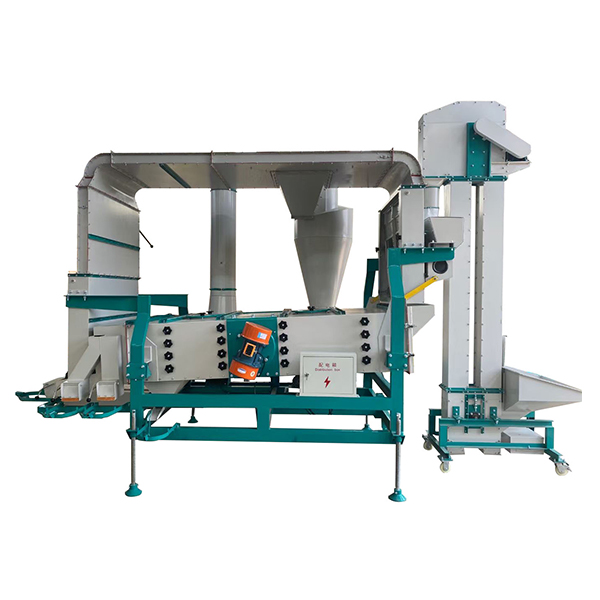
The entire line features automated integration, balancing flow rates across lifting, cleaning, gravity separation, polishing, and discharge stages to prevent blockages or idle running; the line requires only 1–2 operators for monitoring, eliminating labor costs associated with manual transport, sorting, and cleanup; optional high-end smart PLC systems provide audible/visual fault alarms and real-time operational data monitoring.
Each main unit is equipped with an independent cyclone negative-pressure dust removal system; dust is collected centrally without leakage, ensuring a dust-free workshop environment that easily passes environmental and food-safety inspections while preventing dust from adhering to and contaminating the beans.
Stable, continuous 24-hour mass production; widened and lengthened screen surfaces and gravity separation decks prevent screen blinding or deck sticking—even when processing raw grain with high sand and moisture content—drastically reducing downtime for cleaning and ensuring timely order fulfillment during peak harvest seasons.
7. Comprehensive support for international trade; deep expertise in the specialty bean processing markets of Africa and South America ensures worry-free exporting.
We have successfully implemented numerous bean processing projects in Nigeria, Mexico, Argentina, and Tanzania, gaining deep insight into the challenges of raw materials with high sand and clay content, as well as local operating conditions.
Equipment features reinforced anti-corrosion construction and upgraded waterproof/dustproof motors, making it suitable for hot, rainy, and dusty overseas environments.
We provide a full suite of customs clearance documentation—including CE certification, Certificates of Origin, and packing lists—along with bilingual operation manuals (Chinese-English or Chinese-Spanish) and videos for remote installation and commissioning.
The equipment utilizes a modular, bolted assembly design for easy disassembly and reassembly; high container space utilization reduces ocean freight costs.
Specialized optimization of gravity separation and stratification targets specific crops—such as high-sand-content pigeon peas and white sesame from Africa, and pinto beans and kidney beans from South America—delivering impurity removal performance far superior to standard export equipment. VIII. One-stop, full-lifecycle implementation services for worry-free equipment procurement
Comprehensive pre-sales services: Free on-site workshop surveys, complete layout plans, equipment lists, energy consumption estimates, and precise quotations; support for customer-supplied local bean samples for free factory test runs, including processing videos and impurity analysis data to visually demonstrate the quality of the finished product.
Integrated production and delivery: In-house manufacturing of core machinery—such as air screen cleaners, gravity separators, magnetic separators, polishers, and bucket elevators—ensures seamless system integration and eliminates compatibility or coordination issues often associated with multi-vendor setups.
Installation, commissioning, and training: On-site installation and hands-on training by domestic engineers; one-on-one remote video guidance for commissioning for overseas clients.
Robust after-sales support: Long-term warranty on the entire machine, with extended warranties specifically for core motors and gravity separator decks; extensive factory inventory of wear parts ensures rapid shipment; 24/7 online technical support for quick troubleshooting, minimizing downtime and ensuring uninterrupted factory operations.
Post time: Jun-26-2026