Across the entire grain value chain—encompassing procurement, drying, milling (rice and flour), seed propagation, and the deep processing of coarse grains—the presence of impurities such as husks, straw fragments, dust, shriveled kernels, soil clods, and stones is a widespread industry challenge. Conventional, basic screening equipment often fails to thoroughly remove these contaminants, particularly stones and grit. This not only causes wear and tear on downstream machinery—such as cleaners, destoners, and polishers—thereby driving up maintenance costs, but also results in poor product quality, lower market prices, and failure to meet quality standards. With years of expertise in the R&D and manufacturing of grain cleaning machinery, Taobo has developed an integrated system combining a grain cleaner and a gravity destoner. This solution offers comprehensive upgrades in processing performance, hardware configuration, operating costs, adaptability, and after-sales support, effectively resolving the challenges inherent in the grain cleaning process. It represents the optimal choice for grain processing enterprises, grain depots, agricultural cooperatives, and grain procurement stations.
I. Double Air Screen Cleaner: Comprehensive impurity removal and precision grading in one integrated system
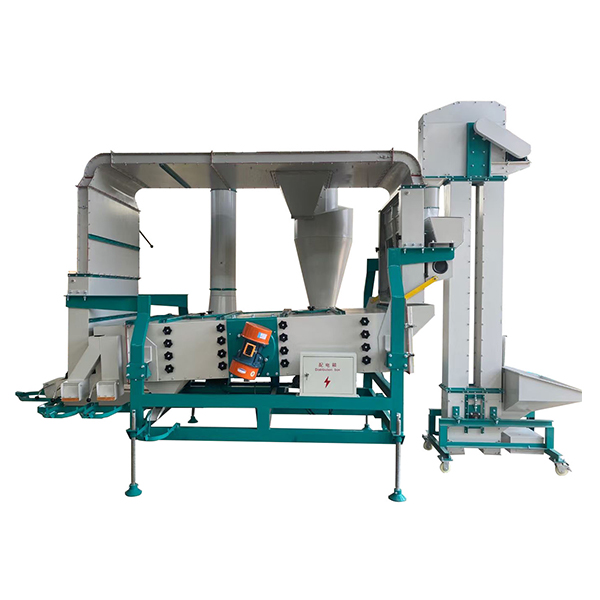
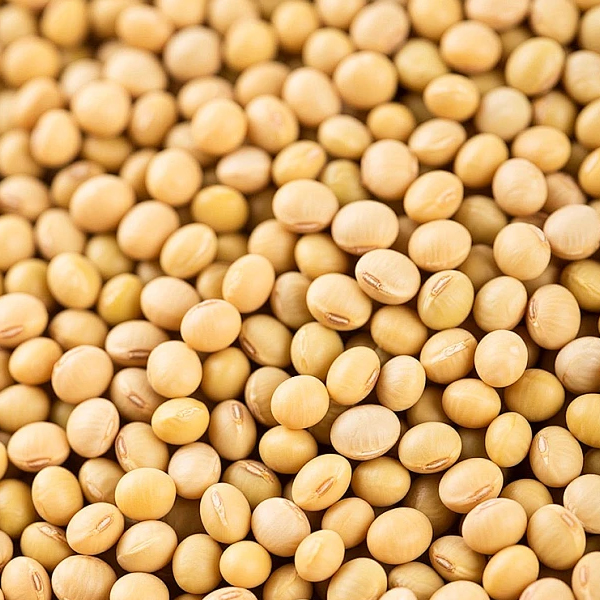
Our cleaning machine utilizes a combined air-separation and multi-layer screening process to handle both preliminary cleaning and precision sorting of grain in one step. It features optimized parameters tailored to the distinct characteristics of soybeans and sesame seeds, perfectly meeting the cleaning requirements for materials of varying sizes and effectively addressing the specific impurity challenges associated with these oil crops. For soybeans: It efficiently removes impurities such as leaves, straw fragments, dust, shriveled or damaged beans, insect-eaten beans, and soil clumps; layered screens precisely separate broken beans, small stones, and whole soybeans, enhancing product quality and laying a solid foundation for subsequent oil extraction and protein processing. For sesame seeds—which are extremely small and lightweight—the equipment allows for fine-tuning of air pressure and vibration amplitude; this ensures the thorough removal of sand, weed seeds, withered leaves, and empty husks without losing whole seeds to excessive airflow, thereby eliminating raw material waste. Processing with this machine significantly improves the cleanliness of oil crops, effectively preventing dust pollution in the workshop and avoiding issues like screen clogging or feed jams. It also prevents impurities from contaminating the crop, which could otherwise compromise oil yield and color, making it an ideal solution for oil processing plants, sesame purchasing stations, and soybean oil workshops.
TAOBO Equipment: Distinctive, Heavy-Duty Advantages
(I) Process Upgrades: Multi-purpose functionality with industry-leading cleaning precision
1. Closed-loop dust removal design for eco-friendly, dust-free operation: Equipped with a recirculating airflow dust removal system, this unit solves the severe dust dispersion issues common in traditional open-fan designs. Its sealed air ducts centrally collect dust and husks, ensuring a dust-free workshop environment that meets environmental production standards. It also recovers grain fragments and intact kernels, minimizing raw material loss.
2. Adjustable parameters to handle materials with vastly different properties (e.g., soybeans vs. sesame): Supports independent fine-tuning of air pressure, vibration frequency, and screen inclination angle. This allows for perfect adaptation to the distinct characteristics of different materials: for large, heavy soybeans, airflow and vibration amplitude can be increased to ensure efficient impurity and stone removal; for tiny, lightweight sesame seeds, airflow and vibration can be lowered with a single click to prevent material loss via airflow or leakage through the screen. Parameters switch instantly between large and small oil crops without requiring screen changes, enabling a single machine to handle both processing lines with maximum versatility—avoiding issues like over-cleaning or incomplete cleaning.
3. Seamless dual-machine integration: Our integrated cleaning and destoning system is factory-calibrated for optimal synergy. The upstream cleaner removes light and large impurities, while the downstream destoner precisely removes stones. The continuous assembly-line operation eliminates the need for manual material transfer, maximizing automation across the entire cleaning line and completing the full process with a single feed.
(II) Durable Materials: Precision-engineered with heavy-gauge construction for double the service life
1. All material-contact components feature food-grade stainless steel screens that are corrosion-resistant, wear-resistant, and dimensionally stable. They do not rust even during prolonged processing of moist grain or raw materials with soil content, ensuring compliance with food hygiene standards and preventing contamination of the grain.
2. The machine body is constructed from heavy-gauge carbon steel using integrated welding techniques and high-quality vibration-dampening bushings. This ensures minimal vibration and low noise during operation. The robust design withstands long-term, 24-hour continuous operation without structural cracking or screen loosening, delivering a service life more than double that of standard equipment made from thin sheet metal. 3. The unit utilizes an international-standard, pure-copper, energy-efficient motor that delivers ample power and boasts a low failure rate; it is highly heat-resistant and resistant to burnout, making it suitable for the continuous, long-term production demands of a factory environment.
II. Specific Gravity Destoner: Targeting Hard-to-Remove “Co-sized” Stones to Close the Final Gap in Grain Cleaning
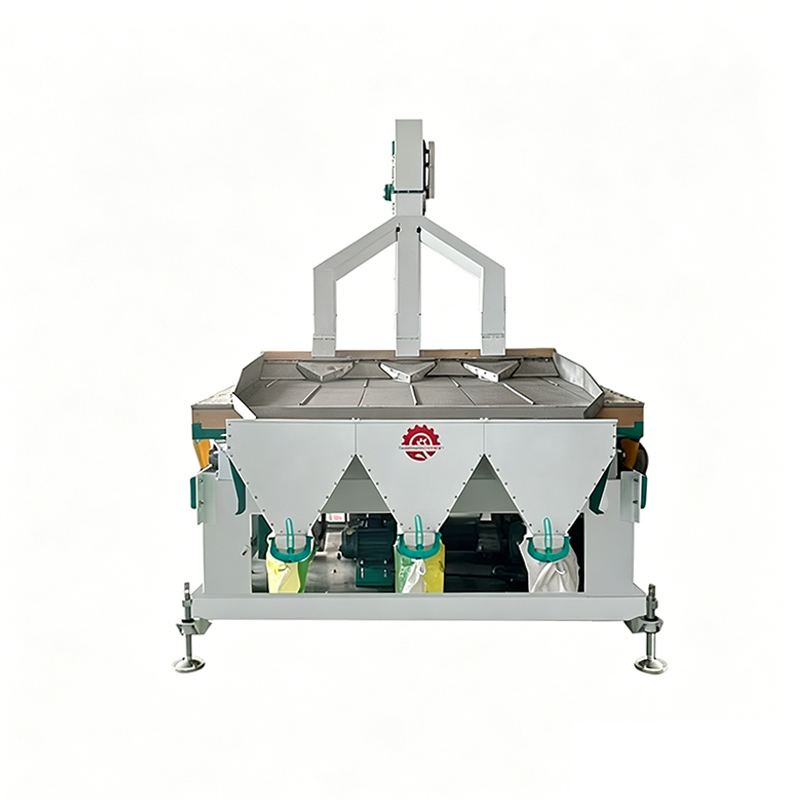
The major limitation of standard screening equipment on the market is its inability to remove stones that are identical in size and shape to the grain itself—so-called “co-sized” stones. In the processing of soybeans and sesame, the risks posed by these stones are far greater than with ordinary grains: sesame seeds are tiny, making it extremely difficult to separate them from mixed sand and gravel; soybeans are hard, so if co-sized stones enter oil presses or dehulling machines, they can easily shatter rollers or scratch the equipment’s internal linings. TaoBo’s specialized specific gravity destoner leverages the differences in specific gravity and suspension air velocity between oilseeds and contaminants (stones/soil clumps) and features a dual-mode adjustment system for different particle sizes. When processing medium-to-large soybeans, the machine increases screen vibration frequency and air pressure to rapidly separate co-sized stones and soil clumps, ensuring clean removal without clogging. When processing tiny sesame seeds, it slightly lowers air velocity and softens vibration amplitude; relying on specific gravity differences for precise stratification, the sesame is conveyed in suspension while stones sink and are discharged, preventing the loss of sesame seeds along with the stones. The equipment’s specialized destoning structure achieves a removal rate of ≥96% for both soybeans and sesame, with minimal grain loss in the rejected stones, effectively solving the most difficult destoning challenges for oilseed crops and protecting downstream equipment—such as oil presses, dehulling machines, and precision sorters—from damage.
We offer more than just equipment; we provide comprehensive grain cleaning solutions. We begin by tailoring machine models and production line layouts to the client’s specific processing needs, hourly output requirements, and facility configuration—all free of charge. Before shipment, every unit undergoes rigorous testing—both unloaded and under load—to ensure zero defects upon delivery. Our professional engineers handle installation and commissioning while providing hands-on video training, enabling even workers with no prior experience to quickly master operations. We also ensure rapid after-sales support, fully addressing any concerns regarding long-term use.
Post time: Jun-18-2026