
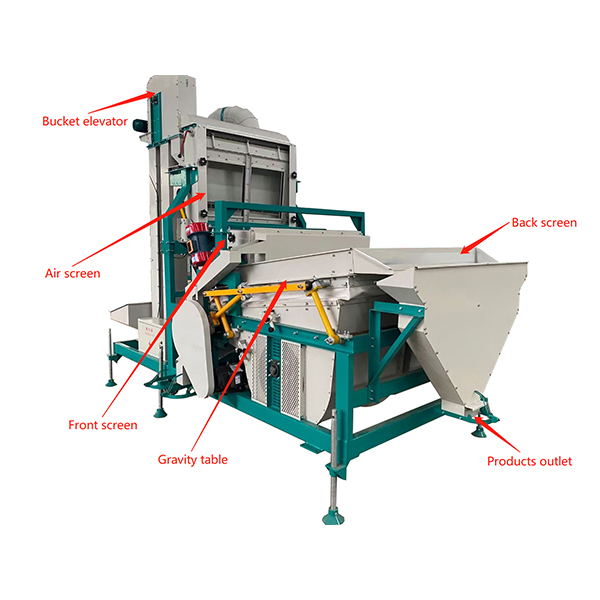
The air-screen gravity separator cleans soybeans and sesame seeds. Its core functions are air separation to remove light impurities, sieving to remove impurities of different sizes, and gravity separation to remove shriveled grains/stones. It utilizes the differences in aerodynamic properties, particle size, and specific gravity between materials and impurities to achieve multi-stage separation. Soybeans have large particles and high specific gravity; sesame seeds have extremely small particles, low specific gravity, and are easily dusted, requiring targeted adjustments to the process and parameters.
I. Core Working Principle
1. Air Separation Principle (Airflow Separation)
Utilizing critical velocity difference: The fan generates vertical/horizontal airflow. Light impurities (dust, straw, shriveled grains, empty shells) have low critical velocities and are carried away by the airflow; qualified seeds have high critical velocities and settle into the next process.
Structure: Vertical air duct/suction channel + adjustable damper + cyclone dust collector; airflow and velocity can be precisely adjusted.
2. Screening Principle (Size Separation)
Multi-layer perforated/woven screens (2-4 layers) for particle size separation:
Upper layer large-hole screen: Removes large impurities such as stones, straw, and bean pods.
Middle layer standard screen: Retains qualified grains, allowing broken grains and fine impurities to pass through.
Lower layer small-hole screen: Further removes dust, fine sand, and debris.
The screen body vibrates reciprocatingly/circularly, causing the material to jump and tumble on the screen surface, improving the screening rate.
3. Gravity Separation Principle (Density Separation)
Material enters the inclined vibrating gravity table. Under the combined action of upward airflow and high-frequency vibration, it automatically separates into layers according to specific gravity:
Heavier, fuller grains sink to the bottom and move upwards along the screen surface.
Lighter grains, such as shriveled grains, insect-damaged grains, moldy grains, and light impurities, float on the surface and flow downwards for discharge.
Stones (similar in size to the grains but with a higher specific gravity) sink to the bottom and are discharged separately.
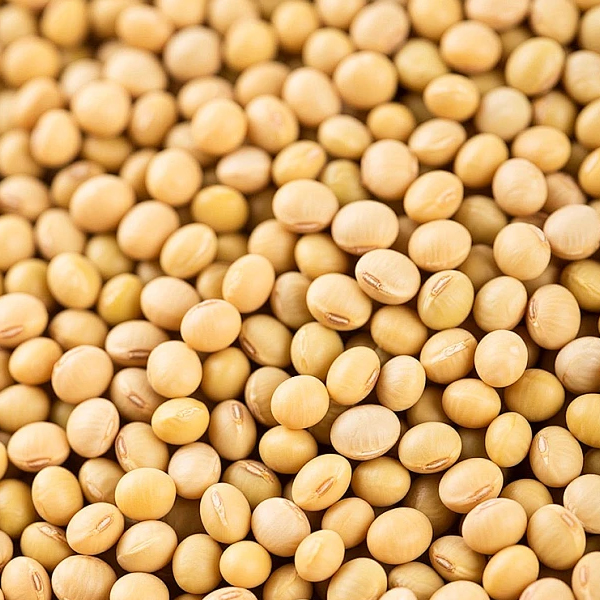
II. Detailed Process of Soybean Cleaning (Large Particles, High Specific Gravity)
1. Feeding and Pre-Air Classification (Removal of Light Impurities)
Raw soybeans are fed into a uniform distribution box via a bucket elevator/screw conveyor, and then fall evenly into a vertical air classification chamber in a waterfall-like manner.
An upward airflow is generated by a blower, drawing away dust, soybean leaves, soybean stalks, shriveled beans, empty pods, and other light impurities. These are collected by a cyclone dust collector and discharged through a closed-circuit device.
The settled soybeans fall into a primary cleaning screen (upper layer large-pore screen, φ12–15mm) to remove stones, mud lumps, pods, and other large impurities.
2. Grading and Screening (Removal of Large and Small Impurities)
After primary cleaning, the soybeans enter a multi-layer vibrating grading screen (usually 3 layers):
Upper screen (φ10–12mm): Retains large impurities and unpodded beans, which are discharged from the machine.
Middle screen (φ7–9mm, matched to soybean particle size): Qualified soybeans remain on the screen surface and are conveyed forward; broken beans and small impurities fall to the lower layer.
Lower sieve (φ4–6mm): Retains broken soybeans; fine sand and dust pass through and are discharged from the impurity outlet.
3. Gravity Separation (Excluding Stones and Imperfect Particles)
The graded soybeans enter the gravity separation platform (inclination angle 5°–8°, vibration frequency 12–16Hz).
An adjustable airflow blows upwards from the bottom of the platform, combined with vibration, causing the soybeans to separate according to specific gravity:
Plump soybeans (specific gravity ≈ 1.2–1.4) sink to the bottom and move towards the upper end, entering the clean grain outlet.
Shriveled, insect-damaged, and moldy soybeans (specific gravity < 1.1) float on the surface and are discharged towards the lower end of the light impurity outlet.
Stones (specific gravity > 2.0) sink to the bottom and are periodically cleaned by the stone accumulation area.
4. Finished Product Output and Impurity Collection
Clean soybeans exit from the upper end of the gravity separation platform and can be directly packaged or proceed to the next process (such as peeling or oil extraction). Impurities from each process (light impurities, large impurities, small impurities, side stones, and imperfect particles) are collected separately and processed centrally.
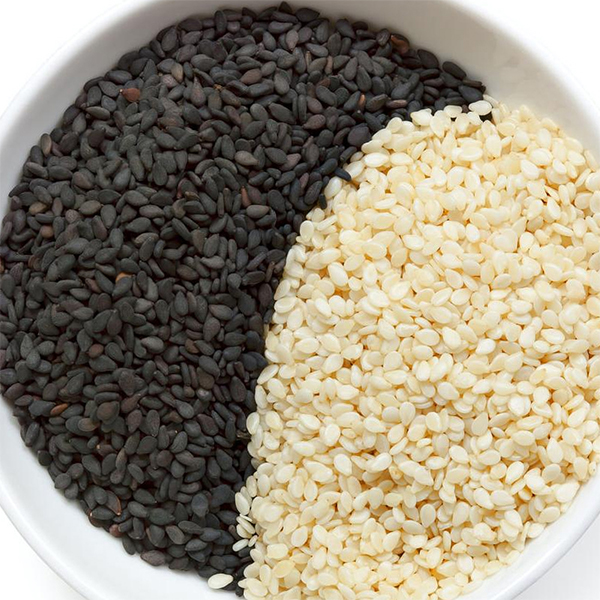
III. Detailed Sesame Process Cleaning (Extremely Small Particles, Low Specific Gravity, Easily Emitted Dust)
1. Feeding and Strong Air Pre-cleaning (Removal of Light Impurities + Micro-dust)
Raw sesame seeds are fed into a double-stage vertical air separation chamber via a sealed bucket elevator (sesame seeds are extremely light, requiring a stronger and more stable airflow).
First Stage Air Separation: Removes floating dust, straw clippings, sesame husks, and shriveled seeds (shriveled sesame seeds have a specific gravity < 0.8 and are easily carried away).
Second Stage Air Separation: Further removes residual light impurities; a cyclone + bag filter two-stage dust removal process prevents micro-dust from escaping.
Settled sesame seeds fall into a primary cleaning screen to remove large impurities such as small stones and straw fragments.
2. Fine Screening (Removal of Small Impurities + Broken Sesame Seeds)
Sesame seeds enter a 4-layer precision vibrating screen (high mesh count, high vibration frequency):
Upper Screen (20–24 mesh, φ0.8–1.0mm): Retains large impurities and unhulled sesame seeds, which are then discharged.
Two-layer sieve (30–35 mesh, φ0.5–0.6mm): Qualified sesame seeds are retained and conveyed forward; broken sesame seeds and fine impurities pass through.
Three-layer sieve (40–50 mesh, φ0.3–0.4mm): Broken sesame seeds are retained; fine sand and dust pass to the bottom layer.
Bottom layer dust collection: Collects fine dust for centralized processing.
3. Gravity-based fine selection (removing stones and chaff): After sieving, the sesame seeds enter a small, high-precision gravity table (inclination angle 3°–5°, vibration frequency 16–20Hz, gentler airflow).
Sesame seed specific gravity ≈ 0.9–1.0, stone specific gravity > 2.0, clear stratification: Plump sesame seeds sink to the bottom, move to the upper end, and enter the clean sesame seed outlet.
Chaff and broken skin float on the surface and are discharged to the lower end through the light impurity outlet.
Fine sand and small stones sink to the bottom and are discharged through the stone removal outlet.
4. Finished Product Output and Dust Removal: The cleaned sesame seeds are discharged from the high end of the gravity meter, achieving a purity of over 99.5%, and can be directly used for oil extraction, roasting, etc.
A fully enclosed airflow system and efficient dust removal solve the problem of excessive dust during sesame processing.
Cleaning Results and Applications
Soybeans: Removes over 98% of light impurities, over 95% of large and small impurities, and over 90% of adjacent stones and imperfect grains, achieving a purity of ≥99%. Suitable for oil extraction, food processing, and seed breeding.
Sesame: Removes over 99% of micro-dust, dander, and shriveled grains, achieving a purity of ≥99.5%. Solves the cleaning challenges of sesame seeds being “light, fine, sticky, and generating a lot of dust,” suitable for high-end oil extraction and as a food ingredient.
Post time: Mar-05-2026