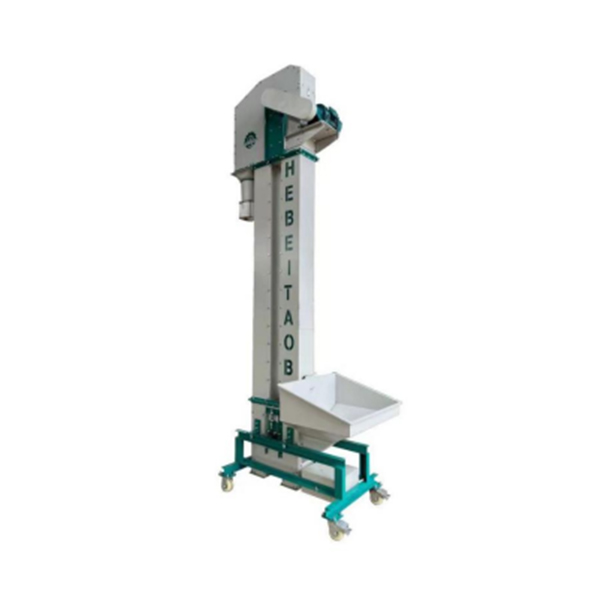
I. Bucket Elevator (Vertical/Large Incline)
1. Working Principle
Core Mechanism: Motor + reducer drives chain/belt circulation. The buckets scoop/feed material from the bottom, vertically lift it to the top, and unload by centrifugal force/gravity. The empty buckets return to the cycle.
Four-Step Process:
Loading: The buckets scoop or receive the incoming grains/beans from the bottom.
Lifting: The buckets move upwards at a constant speed along the vertical casing.
Unloading: The material is thrown out or poured into the discharge port after passing over the head wheel at the top.
Return: The empty buckets return downwards to the next cycle.
Unloading Methods:
Centrifugal (Common): High speed, suitable for free-flowing granular materials such as wheat and corn.
Gravity: Slow speed, suitable for wet, clumpy, or heavier materials.
2. Structural Features
Traction Components: Belt/Ring Chain/Plate Chain.
Hoppers: Fixed to the traction components, continuously arranged.
Casing: Fully enclosed, dustproof, leak-proof, and breakage-proof.
Drive/Tension: Head-driven, bottom-tensioned.
3. Characteristics in Grain Cleaning
Advantages: Minimal footprint, large vertical height (up to tens of meters), good sealing, low breakage rate, suitable for continuous high-volume conveying.
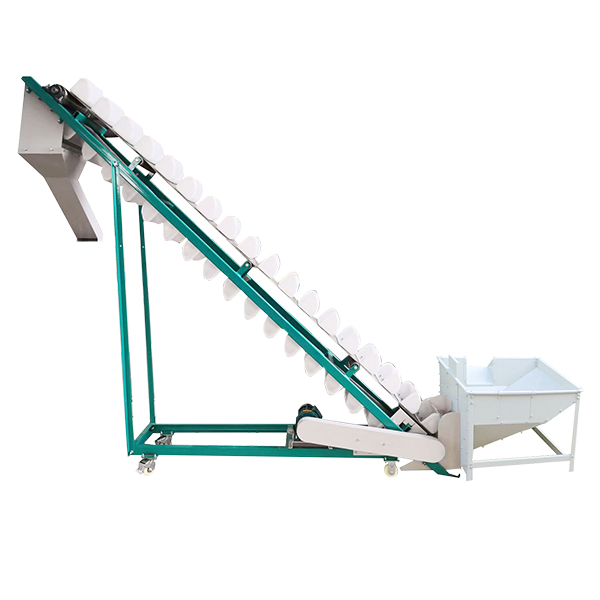
II. Inclined Elevator (Inclined Track/Large Angle Belt)
1. Working Principle
Rail Type (Single Bucket/Cart): The cart runs along a fixed inclined track, pulled by a wire rope/chain; loading at the bottom, automatically tilting and unloading at the top, then returning to its original position.
Side Belt Type: A belt with corrugated sidewalls and crossbars runs along the incline; material is lifted upwards between the crossbars and naturally discharged at the top.
Core Difference: Material is continuously/intermittently conveyed on an inclined surface, rather than being scooped up by a vertical bucket.
2. Structural Features
Rail-mounted: Frame, inclined rail, wheeled trolley, winch/chain drive, limit switches.
Sidewall conveyor: Corrugated sidewall conveyor belt, idler roller assembly, drive drum, tensioning device.
3. Characteristics in Grain Cleaning
Advantages: Can be tilted at large angles (≤90°), can be combined horizontally and inclined, flexible installation, suitable for short-distance/directional lifting, simple maintenance.
Limitations: Larger footprint than bucket elevator, limited height, generally poor sealing, prone to dust and breakage.

Bucket Elevator Application Scenarios:
For applications requiring vertical upward conveying at significant heights, such as lifting grain from the ground to storage silos, upper levels of cleaning equipment, and high-level feed inlets.
For production lines with compact space, minimal horizontal footprint, and only vertical movement.
For scenarios with high dust and breakage prevention requirements, such as continuous conveying of grains and legumes like wheat, corn, soybeans, and sesame.
For main cleaning and processing lines with high output and requiring stable, continuous feeding.
Inclined Elevator Application Scenarios:
For applications requiring only low height, inclined feeding, and short-distance connections between equipment, such as feeding between cleaning screens, destoners, and gravity separators.
For locations where vertical elevator installation is inconvenient, requiring inclined placement and flexible transitions.
For auxiliary feeding stages with low output, less stringent height requirements, and a focus on simple installation and maintenance.
Some models can include a horizontal section, achieving integrated horizontal and inclined conveying without the need for multiple transfer devices.
Post time: Feb-10-2026