
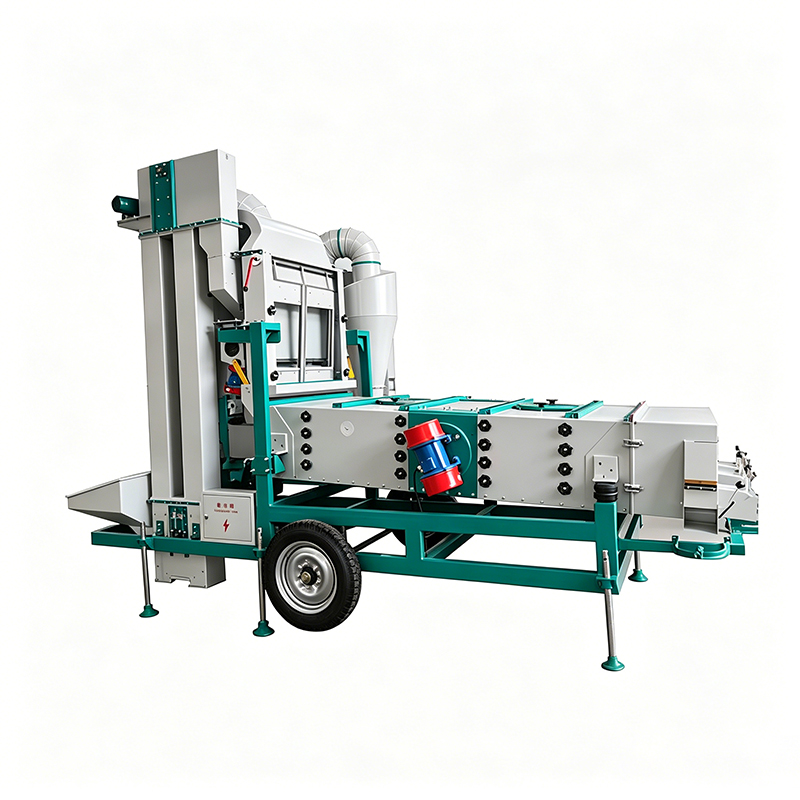
Functions of Each Equipment Unit in the Dry-Process Sesame Cleaning Line (Mainstream Standard Process: Feeding → Preliminary Cleaning → Air-Screening → Destoning → Magnetic Separation → Gravity Separation → Color Sorting → Grading)
1. Bucket Elevator / Pneumatic Feeder
Sesame Processing Line Layout
Serving as the material transport system for the entire line, this equipment lifts and conveys bulk raw materials from the storage bin to the subsequent processing stage. It features an enclosed, dust-proof design that prevents damage to the sesame seeds. It is equipped with an air-lock discharge mechanism to prevent dust leakage, thereby ensuring continuous, automated feeding.
2. Rotary Preliminary Cleaning Screen (Initial Pre-cleaning
Air-Screen Cleaner
The first stage of coarse impurity removal: Utilizing a rotating drum screen, it removes oversized impurities such as clumps of grass, straw, soil clods, stone clusters, and twine. The screened sesame seeds proceed to the next stage, effectively preventing large debris from clogging downstream screens and fans, and reducing the operational load on subsequent equipment.
3. Air-Screen Cleaner (Core Pre-cleaning)
Integrated System: Multi-layer Vibrating Screens + Recirculating Air Separation:
Upper Coarse Screen: Screens out oversized impurities, weed seeds, and clumps of soil;
Lower Fine Screen: Screens out fine sand, broken sesame seeds, and fine grass clippings;
Air Aspiration Channel: Draws away hollow/shriveled sesame seeds, hulls, dust, and light impurities, with a cyclone dust collector capturing and centralizing the collected dust.
Function: Removes over 65% of impurities—ranging from coarse to fine, and heavy to light—thereby completing the foundational sorting of the sesame seeds; it serves as the primary cleaning unit for the entire processing line.
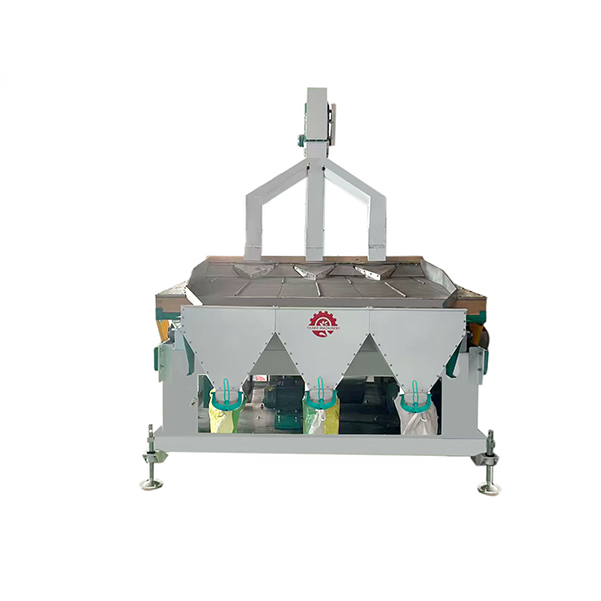
Working Principle of the Sesame Gravity Destoner
Core Principle: The machine leverages the differences in density and suspension velocity between sesame seeds and stones. By combining vibration with a vertical, penetrating airflow, it achieves effective stratification and separation.
Airflow Action:
A fan generates an upward-blowing airflow that passes through the sieve screen. Sesame seeds—being less dense and lighter in weight—are lifted and suspended by this airflow at an appropriate velocity, floating in the upper layer of the material stream. Conversely, heavier materials such as gravel and clumps of soil—being denser and heavier—cannot be lifted by the airflow and remain resting firmly against the surface of the sieve screen.
Reciprocating Vibration of the Sieve Surface:
The sieve surface undergoes a low-amplitude, reciprocating vibration. It is positioned at an incline, with the feed end situated lower than the stone discharge end.
The suspended sesame seeds in the upper layer naturally slide downward along the inclined sieve surface toward the lower end (the product discharge outlet) and are expelled.
The stones in the lower layer—which remain in contact with the sieve surface—utilize the vibration to “climb” the incline; they move in the opposite direction toward the higher end (the stone discharge outlet) and are expelled.
Coordinated Adjustment of Air Volume and Sieve Angle:
Insufficient Air Volume: The sesame seeds are not sufficiently lifted and remain mixed with the stones, preventing effective stratification.
Excessive Air Volume: The stones are lifted by the airflow and become mixed into the finished sesame product.
By precisely adjusting the fan’s air damper and the inclination angle of the sieve body, the machine can be finely tuned to match the specific particle size of the sesame seeds, thereby ensuring stable and reliable stratification.
Key Features of Sesame Destoning:
Given that sesame seeds are small in size and light in weight, the equipment utilizes a fine-perforation “fish-scale” sieve plate design. This configuration allows for lower air pressure and a gentler airflow velocity. Consequently, the machine is capable of separating “companion stones” (gravel particles that are similar in size to the sesame seeds) without inadvertently blowing away intact, high-quality sesame seeds. This effectively removes companion gravel and soil clumps from the raw material.
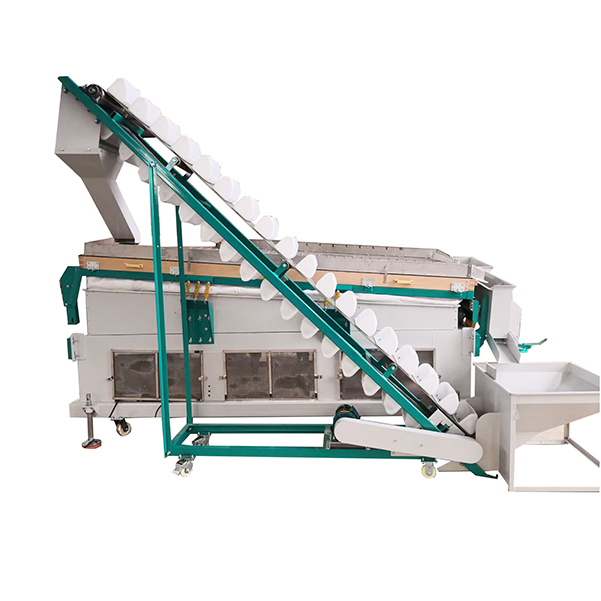
6. Gravity Separator (Deep-Level Sorting and Grading)
Performs refined sorting building upon the preliminary wind-sifting and destoning stages: separates moldy grains, insect-damaged grains, shriveled grains, sprouted sesame seeds, discolored foreign seeds, and fine sand particles. High-quality sesame seeds of uniform size are collected for concentrated discharge, thereby further enhancing raw material purity and reducing the workload for subsequent color sorting. This unit is primarily utilized for the fine processing of export-grade sesame seeds.
7. Dedicated Sesame Color Sorter (Finished Product Refinement)
Sesame Color Sorter
Utilizes high-speed cameras combined with pneumatic valves for color-based sorting: removes white sesame seeds from black sesame batches; eliminates yellowed, browned, or moldy grains, stones, and discolored weed seeds from white sesame batches. This serves as a critical piece of equipment for the final grading of finished products; purity levels can reach 99.98%, meeting the rigorous standards required for food-grade applications, export markets, and advanced processing (such as hulling).
8. Grading Sieve (Optional Accessory)
Grades sesame seeds based on particle size, separating them into large, medium, and small grains, as well as broken fragments. Following grading, the seeds can be packaged into distinct categories to suit various specific applications (e.g., oil extraction, baking, hulling, or export packaging).
Post time: Jun-02-2026